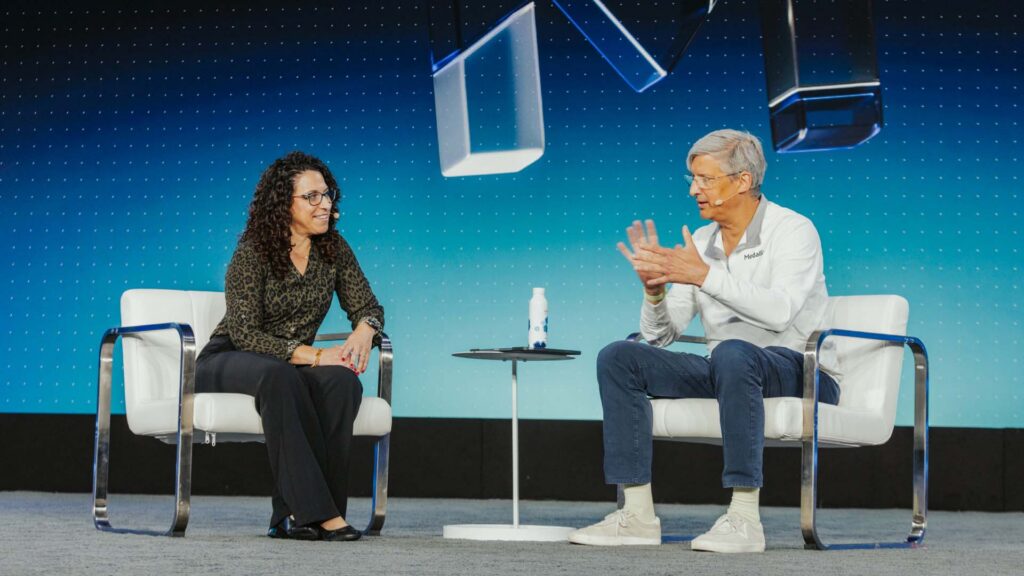
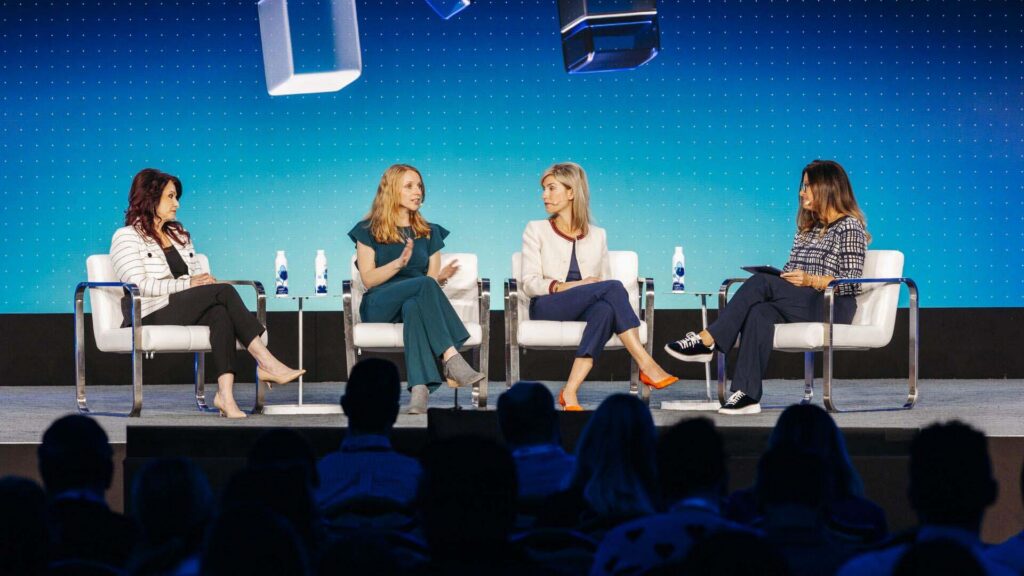
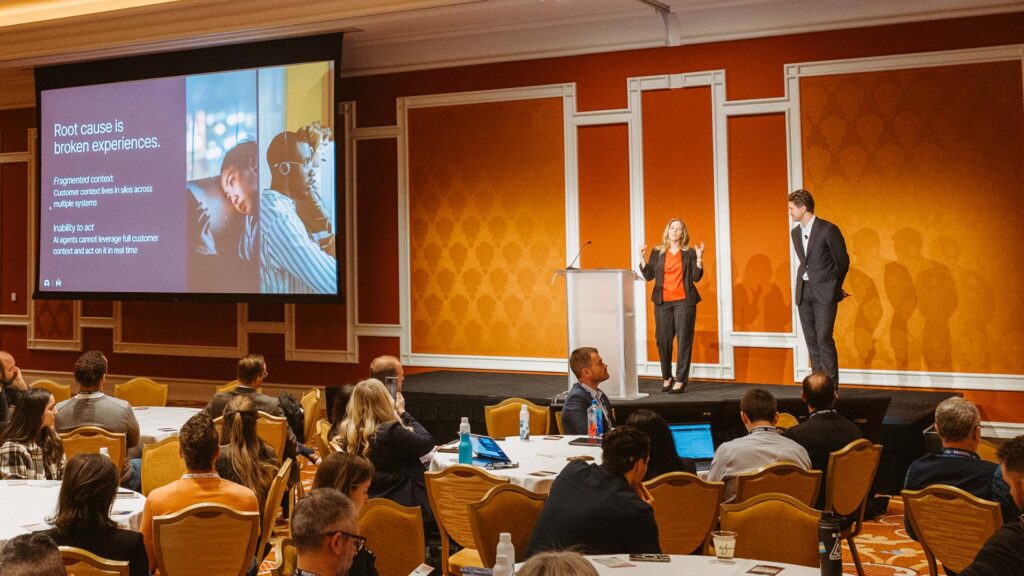
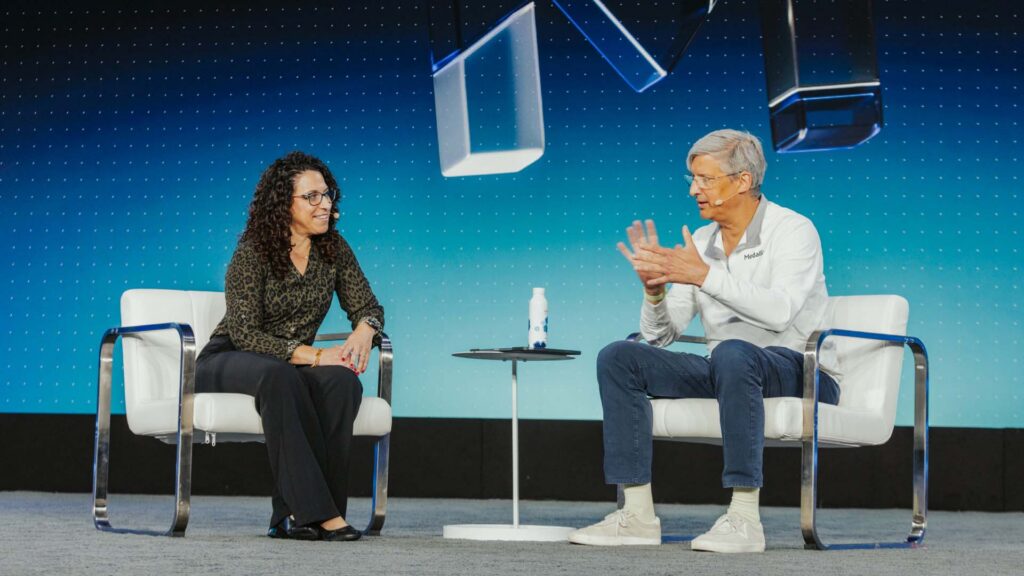
Announcer: [00:00:00] Ladies and gentlemen, please welcome to the stage, RanDee and Kristin.
RanDee Platt: Hello, my name is RanDee Platt. I had customer experience and customer communications for Santander Bank here in the us. If anybody’s, show of hands, who’s familiar with Santander? Wow. I like travel in circles of people who act like that’s a foreign word, which it is when I say it and have no idea that it’s a bank.
So that’s pretty impressive. We’re a global bank the world’s largest consumer bank. Yes, bigger than Chase. We like to say that globally, our retail footprint in the US is in the upper northeast. And some of you may have seen that last week we announced our intention to buy Webster Bank or acquire Webster Bank in the upper Northeast, which will make us one of the 10 largest banks in the us.
So very exciting. But what we’re really excited to talk about is our evolution of customer [00:01:00] experience. And I’m gonna let Kristen introduce herself and then we’ll get started.
Kristin Boyd: Yep. I’m Kristin Boyd and I’m director of Customer Journeys and improvements at Santander.
RanDee Platt: That was fast.
She’s like, let’s get this show on the road. And then I just very quickly want to introduce, I have one other team member here who’s maybe gonna have to answer some questions. If you guys throw us any tough balls, who leads our insights, VOC and customer advocacy programs, and that’s Kaitlyn Denon right here in the front.
So in case we have her here too, if you ask us hard questions about modernizing the insights. So what Kristen and I are gonna really talk to you about is a word. How we navigated a word or two words rather, that you all probably talk about pretty often in your business. I would imagine it’s a word you talk about digital transformation or transformation, right?
You’ve gotta transform the business. For us, that was a little bit scary three or four years ago. That journey started for us. [00:02:00] Kristen and I and our team started to get. A bunch of inquiries on how CX wanted to participate in these siloed initiatives that were gonna have customer impact. And we got to a place where we said, oh, wait a minute.
This is going to potentially be very bad for us. And so what we wanna talk about is how we navigated that, predicament we were in, how we protected growth during dis disruption when quite frankly, probably most teams would struggle to operate at all, and that required a lot of effort from my customer experience team.
It’s not a story about products and tools and capital expense investment. I wanna be very clear there was none of that. We didn’t have money, we weren’t investing. We had to work within the box that we had. And what changed for us was how we showed up for the business and became a key [00:03:00] lever of retention and growth.
So that’s what we’re gonna talk you through today. We wanna show you very real examples of how we did that and how you might be able to do something similar in your business and how that really has made us a sinner of impact at Santander. By materially driving business outcomes. And for us as a bank, that is reducing attrition, protecting deposits, which is our bread and butter, right?
We make money by taking deposits in and lending money out. So having those deposits is critically important to us and how we improve loyalty while fundamentally changing the way the customers interact with us as a bank and a brand. No capital expense investment, no new tools, no extra resources. But this gives you an idea of the convergence that we were dealing with.
And when I say the type of changes that we were undergoing in a transformation, we needed to take paper really out of the business as much as possible. So how many of you [00:04:00] still get a paperless statement today for any of your bank products? We were migrating product, rationalizing our product set, taking our products from hundreds to just a few, getting out of safe deposit boxes and other services, like not doing non-customer transactions.
I see a lot of people shaking their heads, right Lot, lots of service reduction in business simplification efforts. And as we started to look at that and, and just for reference, alloy 2.0 on the bottom. Is branch closures, right? Reducing our physical footprint, which is a major undertaking for us, and the most impactful change we can make for our customers.
So we started looking at the convergence of these issues, and that’s where we started to get a little bit nervous because there’s not just one change that’s gonna impact a customer, but these were decisions that were made, right? We knew as a business these things had to change. So no one came to customer experience necessarily and said, Hey, what do you think about these changes?
Right. I also wanna [00:05:00] be clear that it’s not a story about CX consulting or advising on if the change was gonna happen for our customers or not. It was, we have to do this if we’re going to succeed. It was, the story is really about how we did that right through execution and through fundamental evolution of how CX interacts with the business.
Some of the other things that we were dealing with was a core migration to the cloud, and really ensuring that we contained the level of change customers were experiencing. What the positioning of that was, and we’ll go through some of that, but probably no surprise to you all. If you’re a bank customer and your branch is closing, you’re told that you’re in a product that you really like, it’s going to change.
It might impact you in some way. You can no longer purchase money orders from us, and we’re closing your safe deposit box within a series of a couple of months. It’s probably no surprise that this isn’t going to bring [00:06:00] delight to the customers, right? We’re we’re way past talking about satisfaction here, right?
No one’s going to be satisfied with us at this point. So the first thing we did was build a case on how we were going to get the business to trust us, right? And let us sit CIT really at the heart of execution.
Kristin Boyd: So the way that we did that, right, right, is we quickly, quickly realized that we couldn’t look at the silo by silo project by project, because that’s not how customers would be experiencing the vastness of these changes.
So instead we looked at grouping, what are the things that customers are gonna go through and segmenting that by, by risk and by value to our customers. And so the way that we group that is, you see, Randy already talked about closures. We had done closures before we were doing them again, we know those were highly impactful.
And we also looked at product. Service discontinuations. And so with that, then we looked at the value of our customers, and you can see we came up with this heat map. One thing I want you to notice is do you see a single CX metric [00:07:00] on that page? This is all about the business and the risk to the business if we didn’t act thoughtfully and intentionally.
So you see in the upper right, we’ve got our highest risk. Highest value customers you can imagine. These are much, these were smaller populations, but impactful for sure. And then over on the left are lower risk, but still impacted customers. So what’s so important about this, right, is how we built, built the trust with the business.
This wasn’t a hypothesis, this wasn’t abstract. This told us specifically where attrition was gonna come from if we didn’t really think intentionally and coordinate the activities and how our customers received the changes.
RanDee Platt: And I, I think it’s important to note this was not, if you go back a few years ago.
Something that we had done before, right? So I wanna make sure that you all know and you hear from us. This wasn’t something that we were well practiced and versed in, and we said, let’s put this together. It took us time. It took us a lot of experimentation and brainstorming on how do we get the business to understand how critical these changes are gonna be to the overall customer [00:08:00] relationship.
And so it is something that took us time and, and a lot of different types of, I would say, kind casting that line out there and seeing what worked. This, of course, is the final product, but there was series of what this looked like beforehand, before we got to this point. We’ve said it, I think a couple of times at this point, about three or four years ago when this journey started for us, CX immediately stopped being about scores, right?
We stopped talking about NPS. We still measure it. Still valuable to us. We still measure satisfaction, still valuable to us, but we stopped talking about scores and we started talking about what mattered to the business. Deposits, retention slash attrition, whichever side of that coin and growth. It became about defending the deposits, retaining relationships, preserving trust, and protecting long-term customer loyalty.
That is so important to so many of us because if you talk to most of your [00:09:00] business teams who are in B2C businesses. You are never going to acquire customers that you have today at the same cost that you did 5, 10, 15, 20 years ago. Right? That long-term loyalty is invaluable. So it was important that we knew the forecast, we knew the risk models, and then we knew that if customers didn’t understand what was happening or felt blindsided, they would leave.
That for us is not about satisfaction, it’s about survival. At that point, as a business, we needed to carry those customers through this period of transformation, and we knew that growth had to happen inside of the box.
Kristin Boyd: So what do we mean when we say inside the box? Right? There were very real constraints that we had to work with.
We mentioned there was no capital expense, there was no new tools. We didn’t have new headcount and no digital enhancements. And like Randy mentioned. We were not changing timelines. These project had been planned. We had resources, it, [00:10:00] marketing communications. The train had left the station, right? And so what that meant for us was how do we help the customers forward?
Medallia was in place, but again, nothing new was coming. So instead of asking what can we build, we had to ask, how can we execute better with what we already have? And that was the shift that put everything in motion for how we would work and continue to carry this forward.
RanDee Platt: We need you to believe us before we tell you how we did it despite these changes.
And I said we still measured it and we’ll talk about more collectively how we did this. Across the top is our global competitive benchmark for NPS. This is how we measure ourself against our peers in the us. I’ve worked at several organizations. It’s by far the hardest benchmark I’ve ever been a part of, but we grew 15 points and NPS over the last three years.
Changed our rank exponentially. We were near last. This last year we finally exceeded the peer average. We’re now on the positive side [00:11:00] of the peer average, and as we thought about Branch as our most important channel, we now ranked number one in our internal benchmark. While our internal measurement really went off the charts from what we expected it to, as we thought about our relationship, NPS, which is.
Our full end-to-end all product relationship. And then our branch transactional surveys also went up. We show you this because we’re, and we’re gonna talk more deeply about what business outcomes that drove at the end. But we know we need people to understand that this was not an all for not, and this was started four years ago for us, right?
We’re not kind of a year or two into it. This is a long journey that we’ve been on. And the way we did that, we became. We stopped being advocates. We stopped being advisors, and to be fair, we kind of stopped doing what the business thought was most important and started doing what we thought was [00:12:00] important from what we saw in the data, what that heat map and other similar exercise showed us, and we reorganized ourselves around that.
So before we were very reactive. We had pretty fragmented insights by survey program and other data sources, and we were kind of organized by individual silo journeys. We have become now the center of orchestration and coordination for most changes. I would venture to say most customer facing change is are managed by our team and I mean our team.
I don’t have somebody who sits on a work stream that’s led by somebody else. We are often leading those work streams. Our work is aligned to business priorities and KPIs. So my OKRs are tied directly to what the business OKRs are tied to. And we have, and I’m sure you’ve heard this a lot. Are very focused on the execution of the actions [00:13:00] that we know need to happen, and I would say that we went from raising concerns to owning the result.
Kristin Boyd: So we know you come here because you want to understand how these things are done so you can take back things to your own work. So we’ll take you through probably the bulk of the rest of our time is how we did this, and we focused our work on five key areas. First is the centralized CX engine, which is how we organized our team to support the work that needed to be done.
Next is how we modernize insights, which is how we use Medallia with our internal data to drive action forward. The governance model that we established in order to bring all of our stakeholders together across these multitude of changes, how we as a team move insights to action to create programs and deliver those programs.
And then lastly, how we own the customer strategy directly impacting customers at the individual level and with new strategies. We’ll jump right into these. So first, when we talk about our centralized CX engine, we had to consider all the change that was coming. And Randy just [00:14:00] mentioned all of our KPIs are supporting the business KPIs, which meant we had to identify the work that would need to be done in order for us to be successful.
And so we really organized the team in four key execution areas. First is the insight generation and analysis. So part of that is Medallia, right in the surveys and the tools, but it’s also the internal data that we’ve been able to connect to our Medallia surveys and tools, and we’ll talk a little bit more about that in a moment, but that’s really what that one is about.
Next is the journey design and improvement. That’s what my team does. We spend a lot of time going very deep on what changes customers will experience on a step-by-step level across channels, unhappy paths. To identify how they’ll understand the change, what friction they’ll experience, customer communication excellence.
This was new for us. This is really about how we communicate to our customers this before we had brought customer communications into our team. It was done either by marketing or ops. Neither of them had that strategic lens of what does a customer need to know? When do they need to know it, [00:15:00] and what’s most important to them?
And so this was a big change to bring all of that into the CX team, but helped make notifications through our, through these changes more consistent for our customers. Then lastly, the advocacy and loyalty programs. This was another new body of work for us where we were creating new programs to directly impact our customers.
Some of that was gifting. We’ll talk about our hospitality standards close quality, closed loop feedback, again, directly impacting how our customers to help them have better outcomes. We talked about Medallia, right? Medallia stopped reporting the past. We said we still measure these things, but they weren’t just a reflection of what happened.
We knew that Medallia needed to help us shape the future. So the first thing we did is we updated all of our programs for accountability. And what that meant, and I’ll give Caitlin all the credit I had to have her refresh my memory a little bit, was go through survey by survey, right? And look at every single question who is the owner of the question, and is it something we can act on if it’s something that didn’t have an owner or couldn’t or wouldn’t be acted on?
What we did was we refined it, we modified it, we [00:16:00] caught some questions to make sure that everything that we got, we could really sink our teeth into. So these improvements really helped with the clarity of the information that we were getting, the alignment to the drivers and just making sure that we could make changes based on the feedback what we’re getting.
But where the rubber really met the road was how we applied these insights. And so these four areas were really critical for us. When we think about change readiness, I think Caitlin has spent countless hours saying, Hey, do we know which customers had their branch closed? Which customers were impacted by IRAs?
Customers went through safe deposit, can we measure them before and after? Right. How many of them went through all three? So the data integrations I think were a huge step for us moving forward because it helped us understand that next level of impact to our customers that we couldn’t previously by able to look at customers who were directly impacted by these changes.
So, you know, that was one key nugget that for us, I think has been grown and grown and grown. And I don’t even know how many internal data points we now have pulled into Medallia that give us that visibility. The next one was the key driver analysis. So we spent a lot of time looking at the key driver [00:17:00] analysis using the tool in Medallia to really understand for our customers what the key drivers were.
And with that, the segment using segmentation, we looked at our overlaid, our internal segments. Onto our customer feedback to understand within our different high value, mid value more mass market customer bases, what was important to them. So as we thought about strategies, we knew what would be most critical to those populations.
And then lastly, the closed loop quality control. This was. Something new where I’m sure you all see it. You see alerts that come in front lines that act on them. You review them and you say, this problem could have been solved, but it still isn’t. So we built criteria within Medallia so that our quality closed loop feedback team gets alerts for those.
Those additional follow up on them. And then we’re testing with that process, we’re testing different rapid response templates to see which are most effective for our customers, and using those templates to scale back to our front minds, so that as those new those alerts continue to come in, we are more and more effective at solving our customer’s problems.
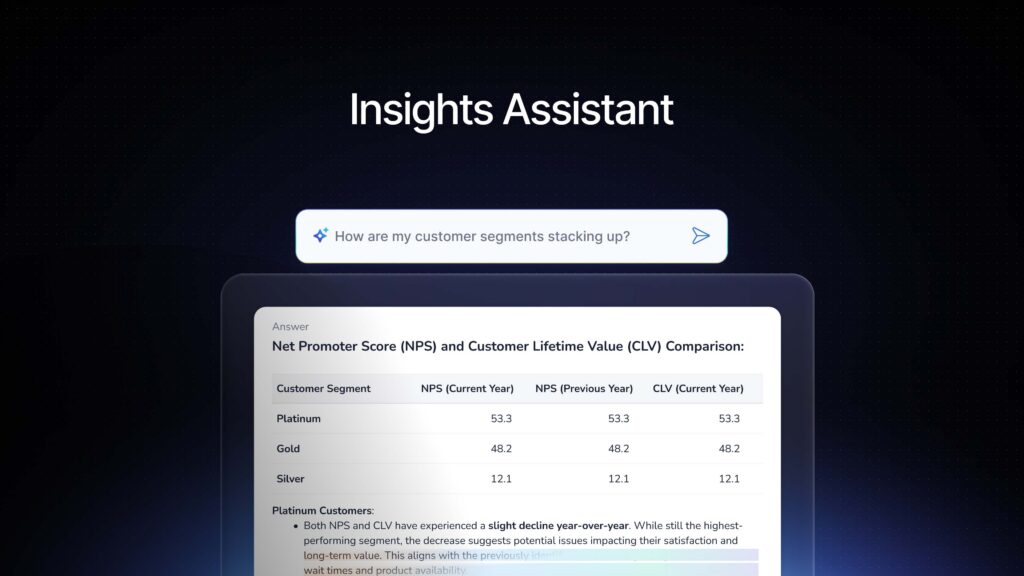
So with this [00:18:00] modernization of our Medallia tool, where we were able to do is transform Medallia into a center of prioritization. What you see here is an example of a dashboard where we were able to bring together not only our VOC, but what were the calls that we’re getting from customers. What were the topics of those calls?
What are the complaints that we’re getting? What are the topics? We then layered in text analytics to go deeper into what the friction points that customers were understanding. Overlay onto that, then what are the fixes that need to be in place for our customers? And are they on the roadmap? Are they not on the roadmap?
Should they be on the roadmap? It really enabled us to have better prioritization discussions with the business by tying NPS to the business outcomes, to be able to say, not only is this, you know, not a strong NPS, or is this a top complaint or call reason, but here’s what’s happening with attrition with these customers, or here’s the balances and how much lower customer balances are when they experience these problems.
So as you can imagine, those prioritization decisions were very critical. And then as we also are, you know, we do report [00:19:00] NPS and as people say, well, look at NPS has been flat, we can say, well, we know what our key drivers are and you know, if the roadmap’s been delayed, we know that we’re not gonna see those improvements until we’re working in those areas that matter most to our customers.
RanDee Platt: And I think this is a critical view of our pivot to not only talking about CX measurement. Looking at impact beyond deposits and attrition. When we’re looking at call, the percentage of calls and complaints, that’s our cost to serve, right? And tying that back to the business in another way from an operational standpoint.
And so you’ll see on the right. If we resolve the issues that we’ve highlighted with on the right of the work to be done, you’ll see what we’re saying is going first to increase average deposit balance and retrieve attrition. We do have real numbers in there but we figured people would wanna take a picture of this and I.
Our team might not appreciate us sharing that information. You know, that’s where then this becomes critical and a really good use case is then when our platform and product teams have to prioritize the work [00:20:00] that they’re doing and they have to rationalize what goes first. They can look at this and say, this is more impactful than this.
I have to do this work first. And they have a very solid business case that’s come from us to them to rationalize that with. Technology and operations, their development team. So it’s, there are many ways that this is used beyond us just delivering this to the business. Probably one of the most critical things or most important shifts that we made is that we aligned governance.
And I think sometimes we say governance and folks think that that is a formal, lots of checking the box and meetings and. What I think is important to understand is governance can be kind of the reorganization or restructuring of routines and how you think about those routines. And that’s really, when we say governance, it was how we organized ourselves around very specific routines to do the work.
And so for us, we stood up what will show in a second, which is a cx, [00:21:00] we called it a CX and marketing forum, where every individual change that was going to impact customers was. Taken in to a cross-functional group of stakeholders that sat on the CX and marketing forum and evaluated the impact to the frontline employees and the customers at the same time so that we could understand where and when and how those changes were going to impact both frontline employees and customers because we know how.
How connected that tissue is, and then really focused on providing once that was taken into the forum, end end oversight of changes, understanding sequencing and timing, and putting those on very specific. And we’ll show an example of that journey maps and then building a unified messaging and retention strategy as part of those efforts.
So as we thought about the forum across the top, that is a group of cross-functional stakeholders. So you’ve got not just customer experience, you’ve [00:22:00] got employee experience, you have frontline readiness you have product leadership. You’ve got really kind of the everybody who’s connected to those changes operations, sitting in that forum, really reviewing the individual initiative strategies so that we can understand really the full gamut of what is occurring in those siloed initiatives.
Asking questions, ensuring that we can really understand how we’re gonna orchestrate, and then bringing awareness of the impact to all levels. And then once that’s done, it funnels down into the work streams down below. Protect and Defend is really focused on understanding the current experience of those customers.
We’ll share what that looks like in a second. Understanding coming out of those into future state journeys and retention, how we would develop strategies around those customers once we understood their journey. Employee engagement and experience was also mapping the frontline customer’s experience through these changes so that how they would find out how they would take care of customers, what the timing of that would look like.
Then building [00:23:00] playbooks around communication so that the positioning of changes to customers and employees were exactly the same, and that the way we talked about changes was consistent time and time again, so that our customers knew what the message was.
Kristin Boyd: One thing I would add about governance is it really reduced the angst in the organization because before we had governance to be like, Hey, did you hear this was happening?
And also this, and then this is happening at the same time. So governance created this, this sense that if a change was happening, it was in the inventory, we knew it was happening, and it was accounted for. And this is every month we pulled together these journeys for each of the cohorts of customers.
And you can see layers of the different changes. The product migrations, the closures, IRA safe deposit boxes. Emails, direct mail, phone calls, right? When are these things actually happening? And this helped us really with two important areas. One is it helped us adjust communications and make sure that we were consistent across those communications.
And it helped us identify where we should be deploying retention tactics, right? Where for our customers that it makes sense to give them the extra touch. [00:24:00] That would help them feel valued as a customer of ours. This was something that was updated each time we had new items coming into the forum so that we always had a clear picture of the changes that our customers would be going through.
RanDee Platt: And this is one of the core cohorts. Do what you saw at the beginning on the heat map, right? So we’re really threading that needle all the way through so that we understand what’s, how sentiment will come about, and again, the timing of those changes. Going back to that heat map that we showed you originally.
Kristin Boyd: So with our modernized insights and with governance, those were part of it, right? But we also knew from the data what was most important to our customers. And one thing that was really important was that human element. And so with that, we used our intel around the importance of those human elements and the knowledge, right?
That every good brand stands for our strong, consistent experience. And so we built a program called the Hospitality Standards, which ensured consistent service across all channels. It really was helping our customers every step of the way. So you’ll see things on here like opening the doors 10 minutes early, closing 10 minutes [00:25:00] late, being ready for appointments, making sure that sound equipment on the phones was good, that we had standards for hold times, that we were walking customers to the door.
So there’s a lot of things on here, right? But that, that meant consistent treatment for our customers. It wasn’t just that we launched this as a nice marketing piece, but along with it, we built visit and observation guides. Every person in our human channels was trained from the top leaders down to all the agents, branch teams and so on.
Received robust trainings. And then with those visit and observation guides, we did quarterly calibrations to make sure that across, across our network and across our call centers, we had consistent treatment and evaluations of that treatment all along the way.
RanDee Platt: I think it, though, probably very notable here, we weren’t looking to differentiate ourselves, but we wanted to make sure every single time a customer interacted with us, they had a same consistent experience regardless of what channel they were in.
Sounds really simple, but this has been one of the most impactful initiatives that we launched that had [00:26:00] no capital expense associated to it, but came from modernizing our insights. I think we’ve said a lot of this and I wanna make sure we leave time for questions, but I think as, as you think about the previous four bodies of work and how we did this, what it has led to is that it has positioned customer experience as really leading.
Now the customer strategy as part of the changes that we make, we’re not asked after the fact. We’re typically brought in very early. We are very proactive in how we think about the how and what execution looks like for us, and that really includes many of the things we’ve talked about, which is mapping and analyzing what the experience will look like before it happens.
Developing communications, playbooks around that, deciding what customer research needs to be done, and then developing very targeted treatment plans and strategies around what we know customers will experience.
Kristin Boyd: So we’ve mentioned retention strategies and treatment plans a couple [00:27:00] times, so we didn’t wanna leave you in the dark on what that meant.
If you think to that original heat map, and we talked about those two high risk, high value populations in the upper right hand corner, these were the strategies that we came with them, right? We knew that there was a difference between what our customers value, whether they’re more affluent or more, more mass market.
But what we did is we really exploited programs that were in place, right? Because you’re probably sitting here thinking, well. Finding a gift is hard because what’s the right gift and how are we gonna get it to everyone? And you know, what are the things that we can do here? So what we did is we exploited existing programs.
Money Market Repricing was something that we used for all of our cohorts, for our affluent customers. We have programs for events. And so this data and Intel let us say, Hey, here’s a group of customers who’s going through meaningful change that’s not on those invite lists. Can we put them on those invite lists?
No additional expense to us, but it did help our customers get that extra soft touch. And similarly, we use our gifting programs in the same way to identify those customers. And then we did use account credits and fee waivers for our more more mass market customers as well. So, you know, I think the key takeaway on this is using [00:28:00] programs that you have in place to offer soft touches as customers are going through change.
RanDee Platt: So we said in the beginning, we bring you back to then what this did for us. I think, you know, this is a result of discipline. For us, discipline around execution, discipline, around orchestration, discipline, around coordination as we think about change management for our customers, and what we realized was that we only had 21% of the projected attrition coming out of this 104% of a product that we thought would a trite.
I think nearly 80%. We retained 104% of the balance goals impacted customers had meaningfully lower balance attrition. Imagine that if you’re being very thoughtful about how you’re touching those customers. Explaining changes to customers and building trust, they’re less likely to attract. We had lots of cost [00:29:00] savings from some of these exercises, nearly $6 million alone in paperless migration.
The upside to that was not only that we stopped serving those customers and paper, but they’re now more digitally engaged. Digitally engaged customers are stickier, as most of you know. And really I think the story to all of this is that our customers stayed, and as I talked about in the beginning, that is more valuable to us than just about anything else.
Kristin Boyd: So you’ve heard us talk a lot about insight, execution, alignment across your teams. So what are the things that you can take away today? We wanted to make sure to leave you with this, which is really four things on the right here that I think made the key difference for us. One is you have your Medallia programs.
Layering in your internal data is what’s gonna take your insights to the next level. Next is finding opportunities to demonstrate impact and building buy-in through those, right? We talked about starting small. Find that project that doesn’t have a clear owner that is creating friction across the business.
Build a business case for it and demonstrate the ROI for it. And that’s how you’re gonna build [00:30:00] momentum, establish governance for transparency across the business. And I think we use lowercase governance, not big G governance, right? Like Randy talked about a way of bringing people together for those decisions.
Then lastly, making sure that your team is set up to support the business priorities so that you are aligned to the outcomes and that the work that you’re doing is helping deliver those.
RanDee Platt: You know, if we would say one thing we want you to take away, if there is nothing else, is that CX doesn’t have to only be an enabler.
CX can be a driver of the business, right? CX can be the executor of transformation. It does not have to be advisory, but you do have to prove yourself to the business. That starts somewhere if you don’t automatically sit in the business. It’s about how we operated our, the way we operated in many cases has now been adopted globally for us as an organization.
And as we said previously, we’re really asked to lead. We’re no longer a cost center that businesses have to just attribute some cost back to and [00:31:00] pay for us. We are a part of their growth engine, which is a very meaningful change for us, and I’m sure would be for many of you. So with that, like any good CX practitioners, we’d love your feedback.
So please feel free to scan the QR code. We’ve got, I think, right about nine to 10 minutes for questions. Hi,
Audience Question 2: I’m Ann Louise Mason from Capital One. And so really excited to hear all of the, the great work that you’ve done at Santander and the long-term impacts that it’s had on the business. One of the questions I have is, I know that there is some acquisition work happening in Santander, and I feel that Eli must be very busy as you are flexing the systems that you have developed and the work that you’ve put in place.
How is this local work at Santander starting to reach forward as you’re thinking about expanding your footprint? And is it something that you have a plan to scale?
RanDee Platt: Yes. So to be fully transparent with you, there’s a little bit of a debate in our organization constantly about where does customer [00:32:00] experience sit.
It’s become a little bit more of an intense debate as of late. The more ingrained in some of the business work we do, and I think probably a never ending debate. One thing that we know for sure as it relates to. Integration work when we get regulatory approval and we make it through that, and we’ve signed on the dotted line is that we know that CX will, as, as you think about even now, we’re going forward, much of what you see here is exactly what we will do, right?
Like this is a rep replicatable process. And so how we think about that will always start with let’s design the experience we want to have by mapping the journeys. We’ll start with segmentation work and a heat map, understanding all of the customers that will be impacted. But what we have done here is really scalable and applicable to just about any type of initiative, including m and a right, that we go through.
In November, we sold seven branches [00:33:00] in Pennsylvania to Community Bank. We did exactly this entire thing, right? We. Understood segmentation of the customers that were gonna be impacted. We did a lot of heat mapping, understood what was at risk for us, ensured that all of the folks involved. Understood.
Did a lot of comms planning and position messaging around that and designed the journey maps and then ensured that then how we executed on the changes for those customers were effectively operated according to those plans. So I think, you know, that is probably one of our bi biggest learning lessons is that what we do here can be scaled to just about any initiative that you’re working on.
Audience Question 1: Hi, I’m Karina from Ship. Thank you so much for a great and engaging talk. I’ll be honest though. I’m a little stuck where you say owning outcomes only because how do, I guess, how do you work together with leadership? You know, every VP has their North Star, has the metric that they own, the initiative that they’re responsible for, but it sounds like there’s maybe some co-ownership happening here.
So can you tell us a little [00:34:00] bit more about that?
RanDee Platt: Yeah, so I, I think I, I’m not gonna I wouldn’t say that it always is really pretty. Over probably the last few years we’ve done a lot of work with business owners. So we have GMs of the business, right? For us it’s deposits and lending channel ownerships, whether that’s digital or in-person contact center.
So we spend a lot of time with those folks on what matters most to them. Right. They have a, a, a million JBI KPIs, right, that they’re tracking and measuring. What’s most important for us to understand is what is most important to them, and how do we engage around the initiatives or the projects to drive?
So I think that there’s, it’s not a super simple, straightforward answer, but we sit down with them in OKR planning, which is relatively new for us as an organization, and really make sure we understand what are the most important things we know you’ve got a lot of KPIs, we’re not gonna impact all of [00:35:00] those.
What are the most important ones that we can drive and still do some enabling around? There are some that we know we’re not gonna impact, but the ones that we know where we can feasibly touch the customer. Those are the ones that then we focus on, right? We know that the actions that we can take are gonna impact retention, are going to impact growth potentially, and then we get really hyper-focused on that and use the insights that we have through the modernization of that program to build around it.
But I, I would say that it’s a continued evolution and reiteration and understanding what we will or won’t touch.
Kristin Boyd: One thing I would add Yeah. Is right. It seems like retention has become a very critical measure because of that cost of acquisition and so, right. Like I would say, if nothing else, we have learned a lot from each of these.
So when we come up with a new initiative, we can look back and say, which of these was most similar, and how did that impact impact atten or attrition or retention of our customers? And that’s become a good way [00:36:00] for us to level set because that while there are different specific KPIs across the businesses, that’s become pretty foundational.
Announcer: You went from a traditional CX platform or strategy, and you went to, you kind of changed it to a different, different strategy. You actually kind of owned the outcome. Did that require you to have to get more executive buy-in to change your overall CX strategy? Did you have to kind of like campaign for that type of model?
RanDee Platt: Trust is earned through work. Right. And so, and being able to demonstrate the value of your work. Right. So as soon as we kicked this off and more individual initiatives came in, we ensured that we were constantly tracking and measuring the progress of the work we were doing and success at key intervals.
That’s the only way, right? I think if you would’ve asked anybody in our organization four years ago from an executive leadership standpoint, do you need CX to be involved in this stuff? Most of most folks would’ve said, no, no, no. They’ll, they’ll tell us what the surveys [00:37:00] say and they’ll track complaints.
And so as we kind of pivoted, we ensured that they understood how effective this work was. And I know that’s hard for some of us because you’re, you feel like you’re elevating the work that you’ve done. You’re putting yourself on a pedestal a little bit, but it is critical that you’re sharing the outcome of the work as it goes, right?
That has to be done. And if you don’t do that, then I think it’s really hard to get buy-in. But that’s one of the ways we’ve been most successful. There’s no question. What we’re working on and how it’s impacting the work because we are constantly sharing that. Kristin and I will hang around. We’re happy to answer any other questions or have any other chats, but thank you so much for being here today.
We look forward to meeting you.