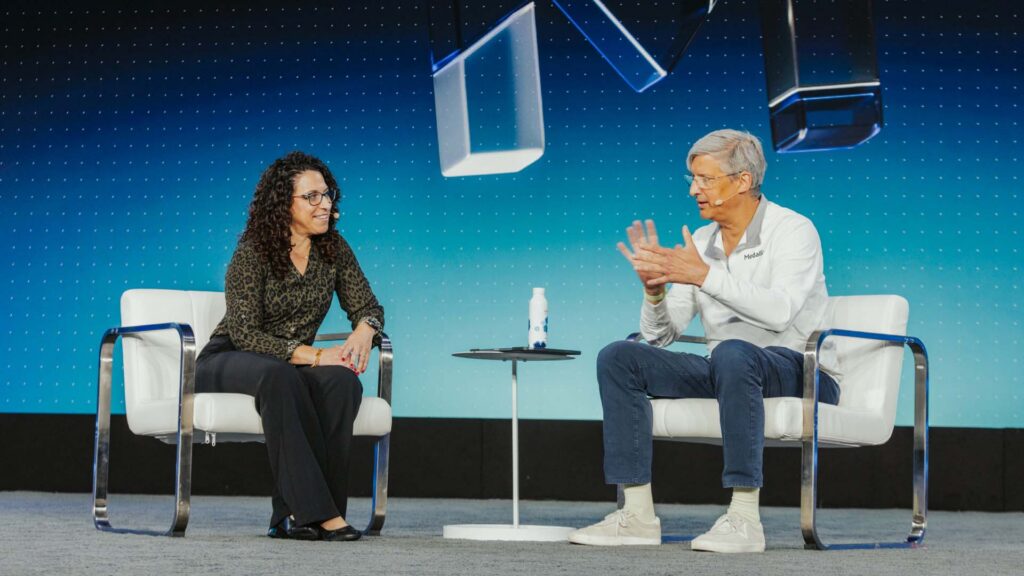
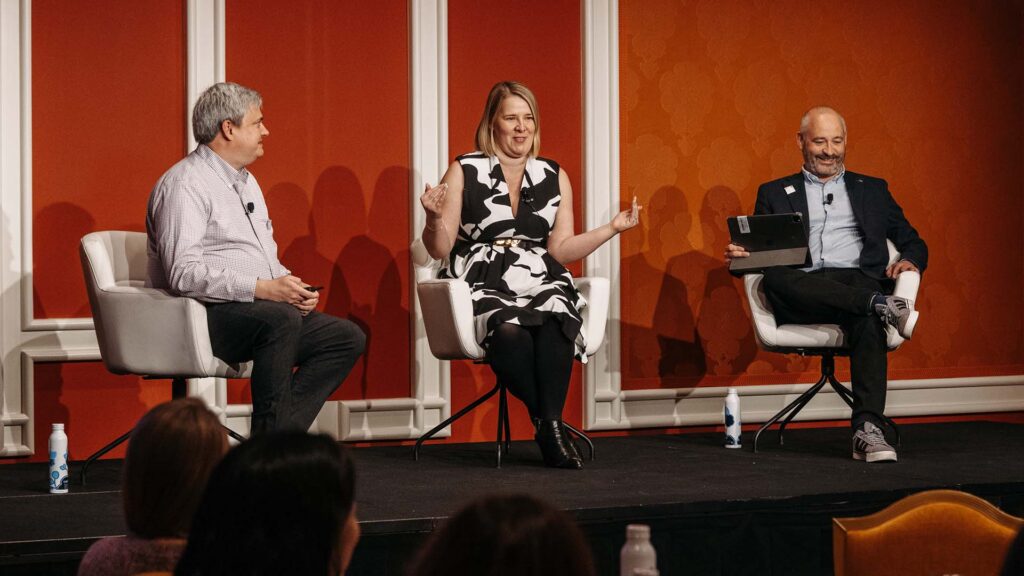
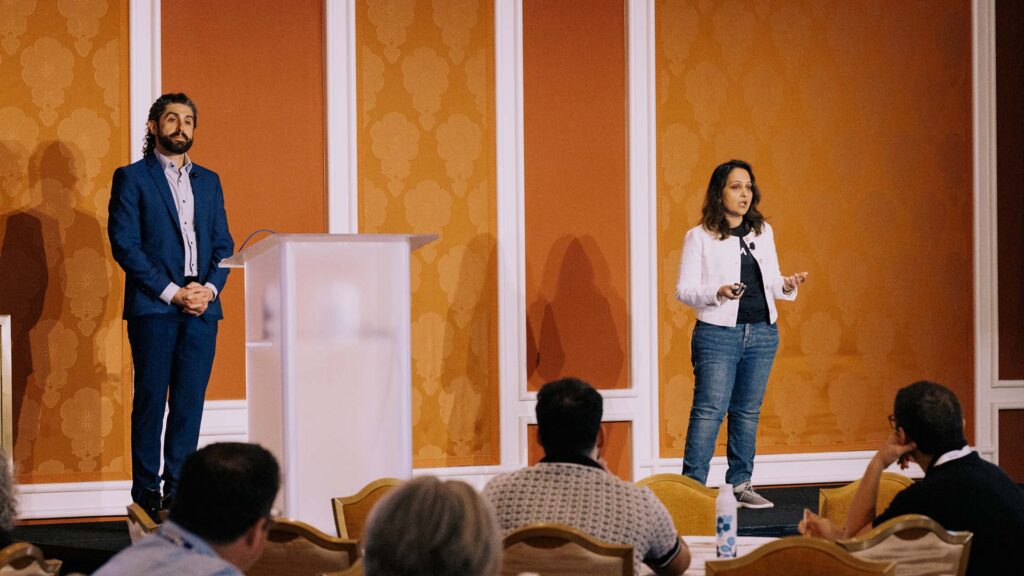
Evangeline Kostos: [00:00:00] My name is Evangeline, and this is my colleague Enrique, and we are very much looking forward to guiding you through this workshop today. So Enrique and I have each 15 years experience guiding clients on CX maturity, and we have. Seen our share of CX evolution and that is what our workshop is about today.
It’s about how you evolve your CX programs, right? And. Honestly, our approach on how we help clients evolve, right? So in our session today, what can you expect? You’re going to be using a maturity framework to give you a snapshot of where you stand today. You will be learning what others do to accelerate CX and remove their roadblocks.
And finally, you’re gonna bring it all together using a prioritization framework, and this will create for you a big. Broad strokes, [00:01:00] big picture guide, essentially, makings of a roadmap for yourselves to help you get from where you are today to driving impact in CX in the future. So the session is gonna go like this.
We will do it in three parts followed by a five minute working session in between. And then after we finish, you will have about 15 minutes to continue working. Please make sure you have in front of you these two handouts. There’s one gray and there’s one blue. Okay? They look like this. You will be using both, but you will also get this information with the digital copy of the presentation that’s gonna be emailed to you.
So in honor of black history Month, this is a famous quote. By Arthur Ash. And if you don’t know, he is the, I should say the late Arthur Ash. He’s a famous tennis player and humanitarian. And why we like this quote is [00:02:00] because it really captures the essence of what we are doing today, right? So as advisors, we’re not merely just sharing our approach.
We’re actually sharing our process with you. And honestly, that’s the fun part. Enrique, can you start us off?
Enrique Gomez Alonso: That means that I’m not the fun part. Okay. Let go. How do we actually move the needle on our CX maturity? And as we saw before, this is a journey. So we use these four steps journey to move the maturity of our other CX program.
First step is get honest on the situation where you are today, knowing where are you, basically where you want to be in three years time based on your priorities and your business priorities on the needs that you have under this. Assessment that you did at the very beginning. Then second, you map the terrain.
Literally you find which are the challenges, which are the opportunities, which are the long-term opportunities and the low hanging fruit opportunities. Then you move [00:03:00] into a prioritization. You start prioritizing the action that will be part of your three year roadmap, and finally you will have a plan.
It’s basically paper without. Reaction without basically the implementation and being able to change the course if the data tell us. Okay, so we’ll follow these four steps. So let’s go to the very first one in order to understand which is your situation and where do you want to give to go? What We will share this basically.
Okay. How we see CX program evolve and when we work with our client, we found them to move in four different stages. Okay? Two. That are really reactive. There is a very reactive stance, two that are more proactive, that basically make your CS program really a powerhouse. Okay. Something that moves the company.
So let’s start from the very beginning. The foundation and the foundation is basically the plumbing is [00:04:00] the survey stage is where you start listening to your client. But you do not have a lot of areas to listen to, okay? You start acting, but basically what you’re doing is the close the loop that is acting on the loudest bo voice in the room.
Evangeline Kostos: Okay?
Enrique Gomez Alonso: So that’s the first one. You then you move into progressing that. Here is where you start picking some unsolicited feedback, okay? You are still thinking on listening to the customer, but let’s face it. You are still in fine and fixed. Okay, you are solving the problems instead of preventing them, then we move into the integrating phase.
And in the creating stage basically is where the magic starts. You instead of looking at individual touchpoint, what you’re doing, it’s looking at whole customer ies. Okay? You are basically moving from fixing what is run to start designing what is next and last. Differentiating. And here [00:05:00] is where we have an omnichannel strategy, where we listen in different points.
We listen in different ways to the customer, but the most important piece is that we proactively are managing the experience. We have an OmniGen orchestrated customer experience, okay? That really help us to make that the CX objective or the business objectives. But here is the hot truth. Most of the program really get stuck.
They get stuck normally in between some in a plate two that is in between progressing and integrated. That’s where we find systematically a lot of programs to get there. Why? Because here it is not about implementing a new listening post or a new technology. It needs a change on the mindset. It implies that you need to stop doing, basically fixing and react.
To really [00:06:00] be proactive and manage the customer experience you need to stop playing defense to start playing offense. And here you can insert a super Bowl joke that I will not make it because I’m Spanish and I have no clue about the Super Bowl. Okay? Here is the thing that we often forget. That is the customer.
Has no visibility of our org chart. Okay? But he help kick and fill our CX maturity level. The CX maturity level is not just an score or is not an score at all. It’s basically what your customer suffer or enjoy as an experience when you’re in the first two stages for the client who looks like they are dating a person with multiple personalities, they talk to.
Support. They talk to sales and basically looks like they don’t talk to each other. Customer needs to repeat. Everything needs to basically cover the gaps that we should be covering and that we do not cover. Okay? So that’s normally the experience [00:07:00] for a customer that is on the first two stage.
Then when you move into the integrating, when you start having these customer journey views, that instead of the touch point view, the customer begins to see some glimpses of. A relationship of a journey. Again, it’s a little bit stitch it. Okay. What I said is the Frankenstein experience. Okay? It looks like it’s a person, but basically it’s made of different pieces, okay?
And when you reach the final stage is when really the experience, because Mogen and orchestrated whatever the customer talks to your contact center or use your app or go to a store. The brand use. One voice, okay. For the customer is really an homogenous experience. They don’t need to really cover the gaps that you’re, that you have, and they don’t need to do all the effort, it looks like a really a relationship with our customer. So that’s basically the first day. So Evangeline, can you guide us through the sign out to action framework?
Evangeline Kostos: Oh yes. As we [00:08:00] heard just now, right? Getting experiences right is really hard for most brands. It’s very challenging for organizations to do and as is actually uncovering what the roadblocks are that is making it so challenging.
After working with many clients over the years, Medallia developed a methodology based on qualitative CX benchmarking, and they did this across industries. And this is what we use to drive our maturity assessments with our clients and help unblock their progress. So what on the screen, take a moment and have a look at that infographic.
What you see there is something called a Signals to Action Framework, and if I may reiterate. This framework is based on, internal company capabilities that we witness from our clients that are successful CX leaders. So there are four dimensions, signals, [00:09:00] insight, engagement, and action. And there are three unique capabilities that we see and CX leaders doing under each.
Dimension. So basically, as advisors, we believe that these are the 12 practices that matter in driving CX evolution. Now the fun begins here. You’re gonna take some time now to assess your organization using these. Turn to this page in your handout, and I’d like you to rank your organization as high, medium, and low as you read through all of the different bullets here.
Going down signals. You read bullet one and don’t think about it too much. Don’t overanalyze. Just use your gut and put a rating down on what you think your organization is. Go down through. And then at the end, I’d like you to aggregate or create an average for each of the four signals to action dimensions here.
And so [00:10:00] when you are done, we’re just gonna take five minutes or so to do this now when you’re done with your self-assessment. I’d like to just show you this page here. Please put your ratings in the first box beside signals to action dimensions here. Just put your ratings down there, the overall ratings.
Let’s get started on your assessments. Enrique and I will be circulating during this time, so if you have any questions, please don’t hesitate to ask. We also have John and Jason as well from Medallia who are. Thank you guys who are also able to answer your questions. So I was working with a CX team and they were doing a self-assessment and they found that they were really high on signals and insights, but they weren’t, they were not.
They marked themselves a low on engagement and action. And so as they did their brainstorming and they thought through how they can overcome those challenges, right? What they put on their roadmap was CX storytelling. And [00:11:00] they also had the idea to restructure their team to match what their strategic priorities were, what their business, their businesses, organization, strategic priorities were.
And their org had just changed and added these journey teams. So they matched up with them, their team, mirroring their team to these journey teams. So I thought that’s an interesting example to share because that’s about what we’re gonna do now, right? Okay, one minute left. Thanks.
Enrique Gomez Alonso: Once that we have established our baseline and where we want to be, okay, whereas this our north stand, it’s time to confront the barriers that are standing.
Basically in our way, in our work daily, we meet clients that cons. We consistently basically see them facing these three billions. The first one is the CX, blind spots and spots, because there are two. First one is the. Basically that most of the program is still fly half blinded. Okay. They are [00:12:00] relying mostly on surveys, and honestly, when your response rate is around five 10.
15%, you are missing the 80% or 90% of your customer. What they are saying, you are blind on that area. Second blind spot is what I call the touch point trap, okay? When you have your teams basically in silos, each of them are winning their games. But the customer is losing the whole match. The second is the lack of action.
We spend 80% of our time doing wonderful dashboard, 20% of the time presenting them, and if I do the maths correctly, these leave us with 0% of our time on doing actions and basically. If you do nothing, you get nothing. And the third, the final billing. Okay? It’s like in the video games, this is really what I call the, show me the money.
If you [00:13:00] do not tie a dollar, sign to a smile, okay? The C-Suite will lose all the interests in you. And basically, this is the one that will make the difference, that will make your program get funded. I’ll get forgotten and unfortunately this is one area that we find that most of the program still fail. To show the ROI, we have seen the three billions.
Then you need to do actions, okay? Some of them will be to overcome the villain. Some of them will be on basically expanding your program. This is a real life example. Okay. We don’t want to keep this in the runs of theory. It’s how we apply this principle to one of our multinational clients. They had exactly the same silos, the same barriers that we’ve been mentioning together.
We map out a strategy across the four dimensions that Evangeline mentioned before. And we try to do a balance between what is. Okay. The immediate impact versus what is the [00:14:00] sustainable growth, okay? What will make us evolve, and as you can see here, is okay in one hand, the quick wins. Something that you can do normally in 90 days that give us this opportunity to show value or to say so change.
Okay? If your program is stagnated, it’s. Showing that you’re moving. But on the other hand, you have to have this long-term transformation that will be basically the one that will do the differentiation in the future. Okay? So keep in mind those two elements, and now let’s bring this back to your work.
Okay. To your world. You’re going to take another five minutes to run this concept in your specific reality. Okay? In your packet, in those slide that Evangeline show us, you have. The second part of the slide that you’ve been using on the, where are you? What I will ask you is that, okay, look at these four dimensions.
Be honest with you, and. Answer to question, where are your biggest opportunities to growth and which [00:15:00] billing is the biggest challenge for you? And don’t worry, by the way, don’t worry to solve all this today, okay? Just trust your guts, okay? We’ll have some time later. For us it’s more that, okay, you start using this.
Okay? And we are happy to discuss this later. So the clock is your for five minutes and we shut up. Let’s see what’s under the hood.
Evangeline Kostos: This blue handout comes in handy. It really helps you it’s like a cheat sheet. It helps you, brainstorm and consider what opportunities you have and what challenges you can overcome.
Okay. So check it out.
Audience Question: Yeah. So one of the things of Angeline that we get asked a lot or we’ve seen is the idea of a North Star. And understanding where your North Star is. I don’t know if anybody caught the session yesterday where Alex from pg e talked about their North Star and how they’ve set a goal that every interaction they have with their clients is a 10 out of 10 across the board.
That’s their company goal. And it’s stated, it’s on the walls, it’s on part of their slide decks. It’s something they talk about [00:16:00] with all of their teams. But it’s something that’s really important that a lot of people skip sometimes. It really helps to understand where you’re trying to go, what you’re trying to do, and.
Where that is, so that if you don’t have a north star or a goal of where you’re going, you might end up at the wrong place. So something to be mindful of. I know you guys mentioned it, but just wanted to add that in.
Evangeline Kostos: So everybody, I see everyone working hard. I love it. I apologize. I know this is a whirlwind and we are a crash course actually.
We’re sharing our process with you, which normally takes so much longer. We don’t have that much time, but rest assured you will have time afterwards to just finish up and we will still be around for questions. Okay we are gonna keep moving here. And I just wanna say, believe it or not, you now have the makings.
Of a CX roadmap. On your worksheet you should be able to see your focus areas. And what are those are the signals to action dimensions that you marked. Low or medium. [00:17:00] So those are your focus areas and then you know, you have been writing in your opportunities and challenges. They will ultimately be on your roadmap, your CX initiatives.
If you marked everything as high capability, that’s okay. And congratulations.
Enrique Gomez Alonso: Come to see us after the world.
Evangeline Kostos: Yeah, come see us. Exactly. But you still will benefit from doing a prioritization of your opportunities and challenges. So that is what we’re gonna do next. What we use is. An intuitive approach looking at each CX initiative and thinking through the business value as well as the ease of execution, looking at each opportunity and challenge, and try not to plot them on this matrix.
So you are going to utilize this slide right here. Okay? And you are going to write in your. The challenges and opportunities for those focus areas. ’cause we need to start somewhere. [00:18:00] Those are the areas that you should start with. Write in your challenges and opportunities, and then plot them in using a numbered circle into the matrix.
Okay. And so for the vertical axis, you’re focusing on strategic impact and urgency for the business, right? And the horizontal axis you’re thinking through, okay, how difficult is this? If it’s a Medallia feature that you’re implementing or Medallia tool or something new with Medallia, that your Medallia team cannot certainly help you with a sort of an effort assessment, but essentially thinking about that internally as well.
’cause your team will also have some effort involved. And don’t forget to think about the complexity of other teams involved within your organization as well. How many people do you have to pull in? Please take five minutes now to just list your main opportunities and challenges on the right hand side, and then this is what it’s going to look like.
This is what hopefully you end up with putting the numbered circles into the matrix. This is a [00:19:00] recent client example by the way. And that’s what the team did. The CX team just brainstormed their initiatives. They thought through what were the most important when it came to their strategic priorities for the business, and they focused them in this framework.
Be that in quadrant one. We have now quadrant two, we have next in quadrant three. Here we have future. That’s on purpose because that is the sequence of your roadmap. Okay? So that’s how you would approach and obviously in, in this quadrant one. Now, those are, those can be considered your quick wins because they are both high value and easy.
Enrique Gomez Alonso: Last stage is basically the most interesting one because it’s when you make things. So imagine three months from now you have your roadmap, you have started implementing your quick wins, showing the ROI, tackling those long standing challenges, and you get some [00:20:00] momentum. So that feels great. No, but here is the reality of the CX world.
Customer change. Market. Swift silos pop up from everywhere. Okay? A new area, a new thing. The roadmap basically cannot be set it and basically forget about the document. It’s a living strategy, okay? So we need to be ready to really move. That’s why you need this control mechanism. We’re talking about the roadmap.
You need a compass. You need basically to have a pulse on the impact that you are delivering, that you are creating. Are you really moving the needle on those KPIs that you thought that were the key one? Or are you progressing on those areas that you were thinking that you need to progress?
Either data shows that you are drifting, you need to react on the fly. You need to basically be able to correct the course on the fly. Okay. Remember a roadmap basically, and the [00:21:00] objective is not to follow one step after the other. Okay? It’s basically to reach the destination again, the joke here is that I, from Madrid, that basically the sea that is closer to Madrid is like 400 kilometers, 500.
That, okay, us that close to the sea in Spain is really far away from the sea. But I always use this example when you are navigating where you’re moving. In the sea, you don’t go straight land. You need to know how to move and drift from one door to the other one. But basically you need to have clarity on what is the final destination that you want to reach.
Okay, so remember the idea is not just basically follow the map is reach the objective. Today we have walked you through this four step journey that start with knowing where you are, knowing where you want to be. Then identify the opportunities and the challenges. Prioritize the action, start implementation and really start proving your ROI [00:22:00] and be ready to.
Correct the course if it’s needed. We hope that this workshop will help you. We will give you a little bit more time to keep on working. It has been our pleasure to work with you today and we will be circulating if you have any question or if you want to clarify anything or work with us.
There’s still some minutes that you can use on that. Thank you.
Evangeline Kostos: Thank you.