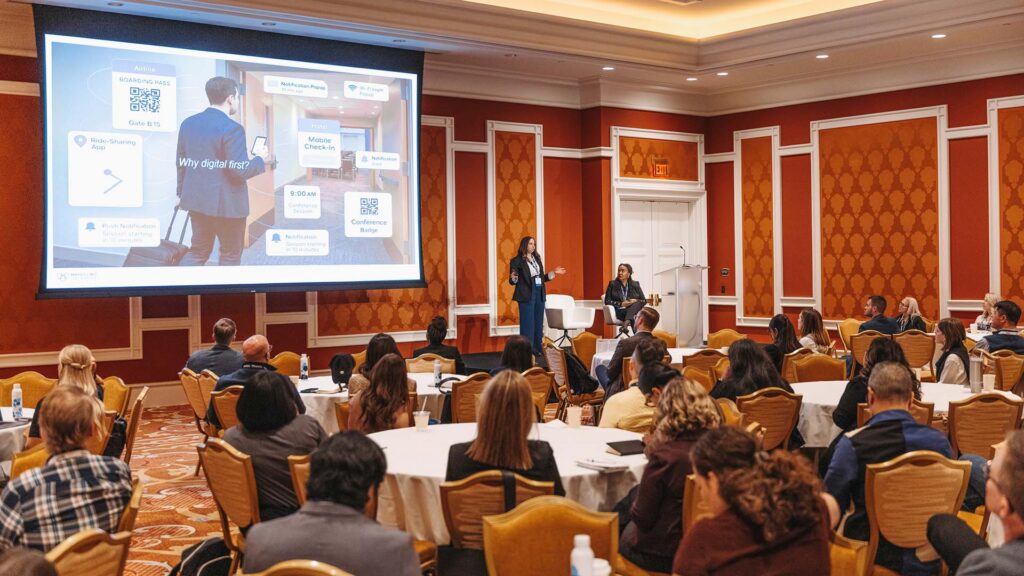
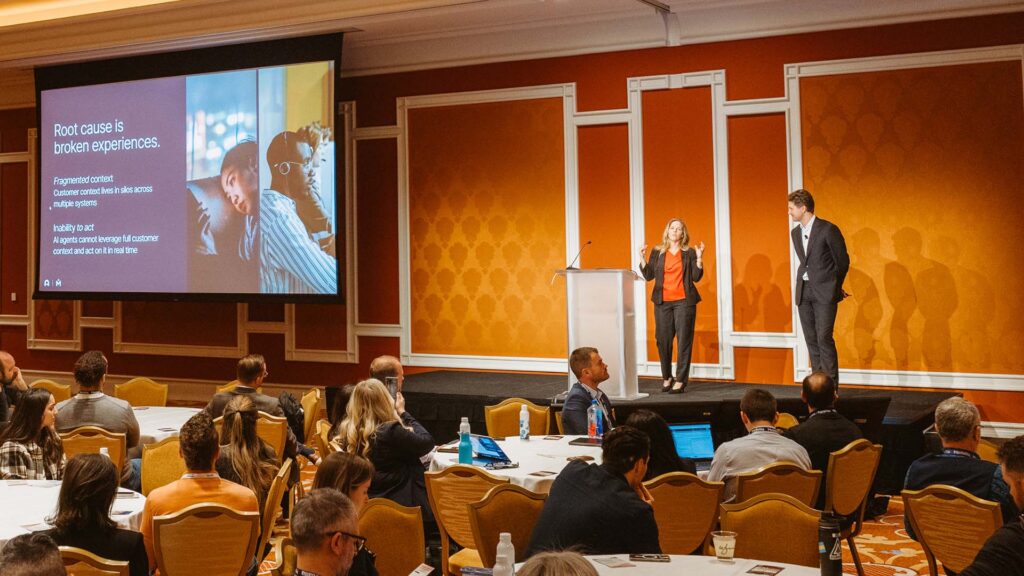
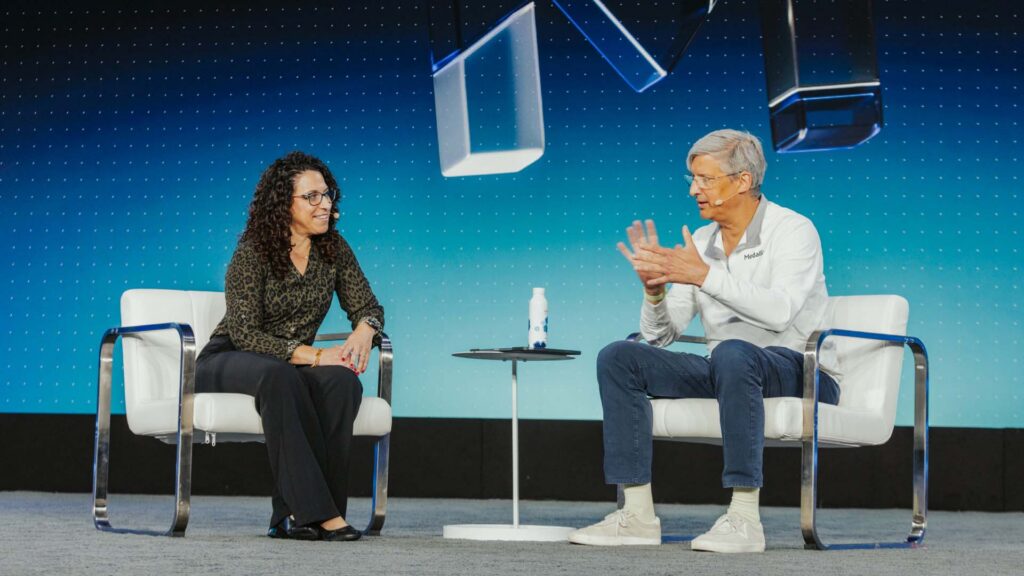
Jose David Rojas: [00:00:00] Today we’re gonna share how we reinvented the digital experience back, what work, what didn’t. And we hope some of these learnings will make your raises feel lighter than before. So our keynote is divided into two big parts. First, you’ll gain deeper understanding on what our obstacles in experience.
Also the best practices we are using to make it easier. Then at the end we’ll also share what future challenges we see coming ahead. Now, let’s talk a little about us. We are part of a much bigger team of athletes at Bar. We are a total of 20,000 employees and we are here representing all of them to share our experience.
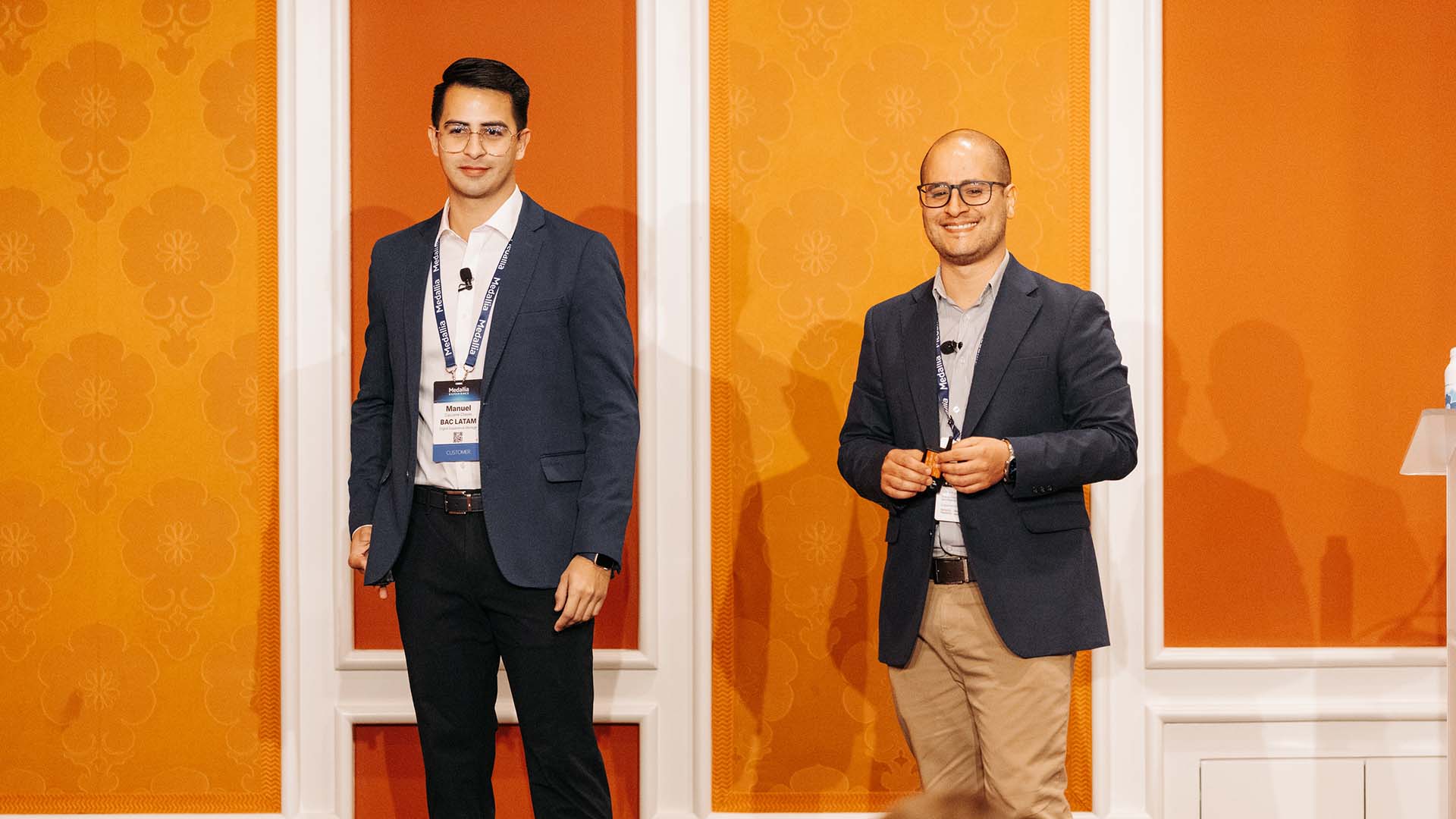
I am Jose David, manager of Digital Excellence. At home. I am also manager of two cats, or at least I try to be because they are the ones that manage me.
Manuel Cascante: Hello everyone. I am ante the [00:01:00] experience manager. I don’t have any cats, but I spend my time trying to visit the all the wonders of the modern world with my friends.
Jose David Rojas: What do we share between us? And probably with most of you, it’s our passion for serving our customers and create wow experiences. So now let’s talk about where we work in. We’re proud to say that Back is the largest private bank in Central America.
Manuel Cascante: Wait, Jose, do you think everyone here knows where is Central America?
Jose David Rojas: Oh, yeah, you are. So let’s give some context for those folks who I think we’re part of South America. So we’ll take a moment to go from Las Vegas down to Central America. To understand, at least in terms of numbers, how complex and diverse this small region is, and also how different each of the customers we serve are.
So Central America is a small area. If we compare it with most of us states, it is less than 2% of the [00:02:00] world surface. And our six countries cover a land area similar to California. And lastly, our customers vary widely. For example, in Costa Rica and Panama, GDP per capita is around $20,000 while the rest of the countries are under 5,000.
We also know that in Central America, internet taxes is around 66%. So although we are trying to be digital leaders, this is quite a challenge. Why do we say we are experienced leader? So here are the stats that will give you a sense of how important is the whole customer experience for us and how important is the digital for our strategy.
We have helped transform a traditionally non-digital region to one in which 65% of our customers are digital. Imagine there were just 35, only six years ago. And we also know our platforms enable [00:03:00] movement of half of total Central America’s GDP. And lastly, this might be the most surprising number. 96 of all our monetary transactions are now done digitally.
Manuel Cascante: When we saw that 96% we were shot, but also extremely proud because it proves how strong back digital transformation vision has been. And now it’s important to us that let that show you how we work to create and improve our digital experiences in back. Our process is based on a double diamond concept and it starts with a survey design stage in which, which explorer and.
We validate some new hypothesis followed by additive research to identify which problems we must solve. And after that, the product design team will work in an interactive cycle. Until we validate our solutions, we are real users. After that, we develop and launch that functionality. In this moment is when [00:04:00] Nalia.
It is very important because we need to know how has been our user experiences, so we are using Medallia. To find bug and identify them, and solving quickly also to identify usability insights that we have to evaluate with the product, same thing. And also to evaluate new functionalities or even new digital products that help our digital users.
And now I know a little bit more about us and how we work. We will share with you Five’s best practices that have helped us to overcome every hurdle in this race. So let’s type into how we use the cheaper and type of service and the potential on tools like test analytics, DHA panel rating, and how we combine all of them looking for the same goal, creating memorable experiences that add value for our customers and for our users.
So the first lesson that we’re going to talk and share with you is to unlock powerful insights using [00:05:00] content surface and user experience. We usually say keep it simple, and that will be very important to this lesson. Just activating surface doesn’t mean that your users will answer that. Activate a new user.
It could be a good start, but when we know exactly what we need to learn, we can ask with intention. So here. We recommend you to use embedded surface at the right spot and use intercept surface at the right moment. So in this phase huddle, we needed to understand if we were able to help our users. So this is an example for a health center, which is a site that we created to let our users to find solution toward the problems themselves, but we were interrupting them before they had even finished reading.
Our understanding the information that we were presenting there, we can wait at the end of a trans at the end of that transfer, at the end of payment to trigger an interface Serb. We sold this issue, leverage the different formats the digital suite offers, [00:06:00] and we tested placing a single question at the end of each article and that simple question, and the result was that we received more than 121,000 more feedback.
Just this year. And that is very important because this feedback help us to identify which articles to focus on to improve them. And then the result was that we reach 60% on the useful information rate. But it is, it reinforces how important it’s to choose the right serb at the right moment and to keep it simple.
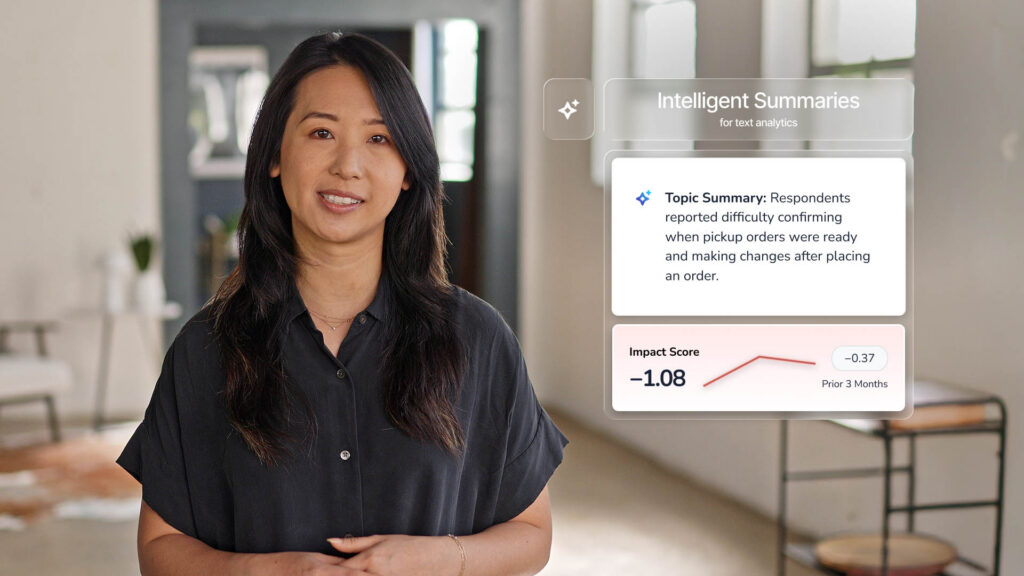
Jose David Rojas: And what is most important manual that we now know? What we have to do and to work to create the biggest impact for our customers. Second lesson, let’s talk about how to prioritize what truly matters. With text analytics, we use text analytics to understand what is affecting our customers the most. Text analytics is one of my favorite features from because it let us organize by topic [00:07:00] each of the feedback that our customers are letting us.
Also have a clear score on how is it affecting our NPS positively or negatively? And with this, it’s helping us to prioritize wisely, to create accountability and to know what exactly. Fixed first, second, and so on. So the question becomes, which opportunity is the more relevant. Because as many of we have and we receive a lot of feedback, so it becomes very hard to understand which one will be more relevant and more impactful for the customers.
So to answer this, we started creating instant rankings by each of the experience cluster. So in this case, the password recovery feature was having the hardest impact on the NPS was a total of four negative points. So we clearly know that we was affecting our program, but we wasn’t quite sure on how much it was.
And also we [00:08:00] think we were missing the message when we saw this feedback that the customer were having. We understood it. For example, Dana Roman said. Back is usually the best in customer experience, but having to go through this torture every 60 days is just awful. Why is that? It was because regulations in El Salvador was forcing customers to change password every 60 days.
So they were very angry. And also Omo. Maua in Panama told us it is impossible to use. The emails never showed up and you won’t even accept the temporary password. This was because to safely identify our customers, we were asking them for a temporary password that we send them to the email. We started prioritizing quick wins with the development team that help us increase our NPS by 38 points, and then.
We started to reimagine and transform the whole experience. So we partnered with our teammates in El Salvador for them to show the regulator [00:09:00] how this measure was impacting our customers. And actually they got it. They exceeded and in one month they increased the 60 days measure to a six months for the password recovery.
So with this, and also by implementing biometrics verification, we eliminated the temporary password requirement. So the flow was very easier and quicker to complete.
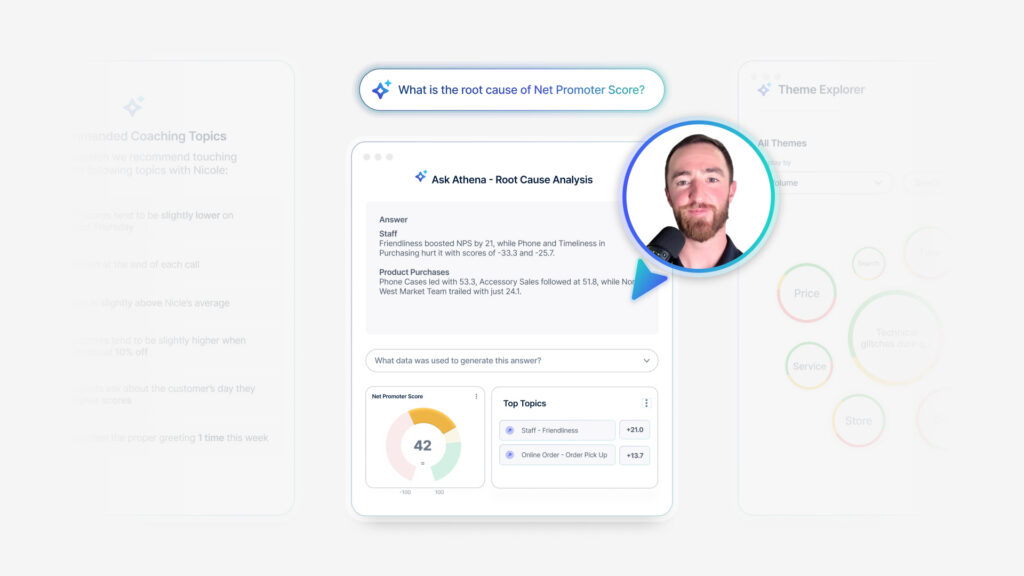
Manuel Cascante: Jose, that’s how powerful text analytics can be and it could be a game changing to your organization. But we were excited because we have Someon as of AI today.
So we’re going to talk a little bit more about this powerful. Tool In our next lesson, now we are going to show you how we combine and evolve the digital tools to drive high impact solutions with all the potential that we already had. We needed to scale it so we create a huddle in each country to go deeper into the feedback and to transforming into concrete [00:10:00] actions.
Then we propose that every huddle create a closed slope process. And that enables two. Number one, to solve, find a solution for a customer. Number two, to analyze what happened. Three, prioritize what really matters. And finally, to take actions. Then we saw much fresh feedback. We discovered that we need to evolve as our dig, our topics in our text analytics as fast as the digital world runs.
So we recommend you to update your topics at least once a year. But if you can do it twice, it will be better. Also, you can check your coverage to stay aligned with users are actually saying, and. Solid recap, creating huddles, closing the loop, and refreshing your text. Analytics allowed us not just to take isolated actions, but to create groups or clusters and help us to transform the feedback into real [00:11:00] action plans.
And here I ask, can we really transform insights into action plans? Of course we can. So let’s see some examples. By grouping everything that we knew and everything that we had measured, we knew that we need to solve some issues at a scale. So in 2023, we present and start like this. For the first time to our leaders showing how security and product experiences were dragging us down almost 12 points on our shared NPS.
We knew that we need to make big decisions, and the first decision that we took was integrate our security code into our main app. And before that, the user have to go and log into a separate authentication app and get a code, copy that code. Return to remain app and also finish the transaction. So that experience just added vision, but not security.
So once we integrate this experience, it becomes simpler and also [00:12:00] even it created a positive impact. In RNPS. This is how it works right now, and it will be very quickly, but now it’s integrated. Another of our painful issues that we had in that moment was our credit card experiences. Credit card is one of our main products, so we have a lot of feedback here and we identify many needs.
So we decided to redesign the complete experience and we add more than 12 new features. Now, as you can see, our customers can see the card can buy on internet using the security codes, and also they can win what Just one touch, activate or block the transactions. It’s very different for the training that we used to have.
We also replaced the NPS question to a satisfaction one. We want to be sure that this changes impact positively and the people find it useful. So when we were short about that, we changed again into an NPS question
Jose David Rojas: and this [00:13:00] change alone, double on customer satisfaction. Surprisingly, we saw almost no resistance to change despite this being one of the customer’s favorite feature.
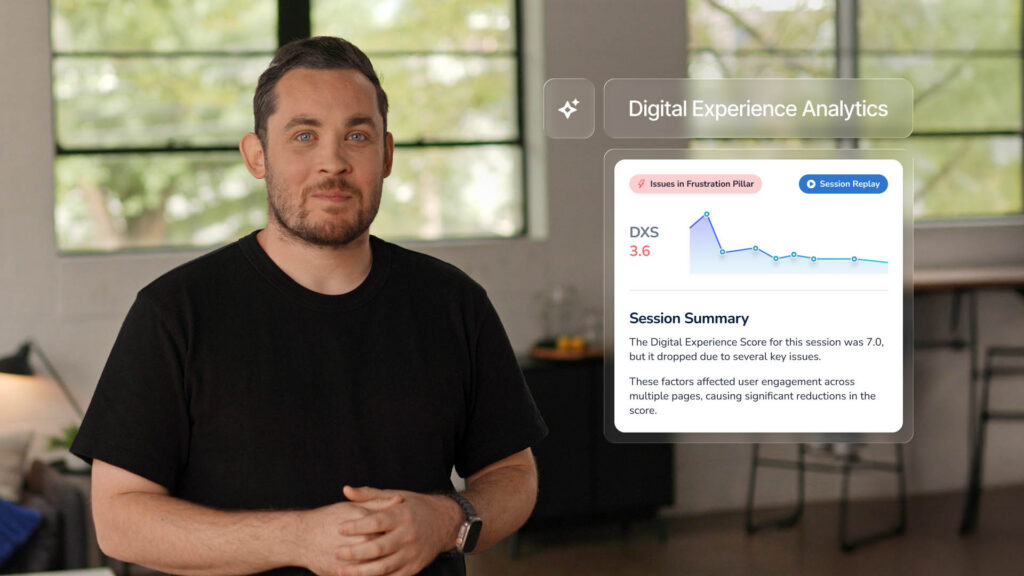
Now let’s see how to extract value from silence. How to discover the feedback we don’t see through service. So with this, we are using DXA, which stands for Digital Experience Analytics. We were already learning a lot from our service feedback. With DXA, we enable a whole new level to start learning from what our customers were doing in our platforms.
DXA is a valuable tool from medal that allow us to measure in numbers, but is the experience our customers are actually having By identifying more than six 60 unique behaviors in our platforms. We were receiving a lot of this feedback. We. Politely call it low quality feedback, because as you can see it tell us nothing.
So Melissa Munoz in Costa Rica says, transfer [00:14:00] aren’t working, please fix it. Or Elia Pena in Honduras is saying I couldn’t make a transfer. So we clearly know that something is wrong, but we don’t know what, where, or what is happening. So this is where DXA can help us extract insights on click or on incomplete.
Feedback that our customers are left in us. It help us analyze behavior, frustration, pattern, technical signals, navigation plans, and more. So the question becomes, how can we go deeper? How can we find insights with zero meaningful feedback? So this is a session replay example, and it’s one of the examples I like the most because it show us how powerful DXA can become.
So I’m gonna replay the video. Please put us the attention. So as you can see here, our customer was trying to make a transfer and once he started to [00:15:00] complete the form, he was clicking to select the account. And as you can see there, he multi clicking. That is a behavior DXA identifies and because of a technical issue, the component wasn’t responding.
So the person couldn’t complete the form, and this was maybe the trouble that we saw in the messages. So I remember showing this exact screen recording to our CEO, and I remember how amazed he was because now it was so much easier for us to identify this kind of issues. And also because now we’re gonna work on advanced behavioral analytics and.
This example just took us one week to find it,
Manuel Cascante: Jose, and it’s important to mention that this bulk bus fits in two hours. But it has affected our customers for weeks. We are going to talk about our last lesson. We are going to talk how to positively impacting how. [00:16:00] Your new potential users perceive us using app rating.
For those who doesn’t know about the rating is a small feature. The users win a quick in-app survey, and with that survey it’s connected to the app stores that mean that the star ratings are directly connected to the app store. In play store. Here, the user can leave. And share their feedback based on the real experiences.
Very interesting number that 79% of the users check the apps rating before. Do need a new app. And this is how this is why UP rating is extremely powerful onto, it seems like a small feature because it could positively it have a huge impact on your reputation, discoverability, and also your conversion.
We have achieved strong ratings in the Upstream Play Store. But this will help others users to know how good a experiences. So before we activate this functionality, I remember that we were stuck [00:17:00] in two and three star ratings, but we don’t know why and what that’s happening. And after we activate this feature, we are leading in four of the six countries and in the remaining ones.
We are almost near to the top. It is also going to mention that this feature is so easy to activate for your digital Medallia suite, and in a few minutes you can have this function working in your own apps. This slide says that Medallia helped us to increase our digital MPS year by year, and it is true, but we really want to highlight here is not only the numbers of cells, but the story behind them.
It becomes very clear. But didn’t get here by accident. These results are outcome of years of listening and learning, and also improving our digital experiences based it on the Medallia tools. And something that we deeply appreciate is that Medallia is always one step ahead every time that we have.
Something to or on an issue to solving a digital program. [00:18:00] They always have the new functionality, the new capability, or even the new way to understand the users ready for us. And thanks to that close partnership, we achieved a 75 positive points on NPS last year, and this is a huge number because the average in banking and financial services around 60.
Jose David Rojas: In this final part of our breakout session, we’ll look at today’s challenges, which we see as new opportunities to keep improving. The first one is a challenge we have with quarantines. For those who don’t know, quarantines are the period where Medallia puts a customer once they completed a Serb, or if they refuse to complete a RP.
So this is quite good if we want to avoid Overserving customers, but in our case. Was preventing us to have enough feedback from the less frequented sections. So now we are moving from one quarantine to several quarantines. [00:19:00] So for example, if a user transfer a Serb at the transfer cluster, we’ll still be able to serve them in security payments and products.
So this is gonna ensure us to have enough and relevant samples for each of the cluster of experience.
Manuel Cascante: Number two is that we need to diversify our metrics in finance, we said don’t put all your ads in one basket. And the experience measurement goes beyond the NPS. So we want to compliment how we measure experience.
And as we learn in the health center example, we can use another metric. Let the useful information rate to. Keep looking for new opportunities to solve and also to diversify our metrics. And this could help us to have better decisions evaluating each one of our metrics, and maybe we have to create a new ones or or our own metrics for some of our needs.
Jose David Rojas: Yes. And as we’re [00:20:00] learning today, everyone has challenges with ROI and how to relate it with experience. We also have, so this one is a challenge we need to solve now, and the third lesson is about implementing new features. So we now know that Medallia has medal video, which is a feature of Medal digital that allow us to receive from our customers video recordings or audio feedback.
So together with DX eight, it will help us identify box and validate box, especially before we launch our new application.
Manuel Cascante: Hi Karaba Jose. I guess that we just revealed one of our secrets, but it is true. Some we’re launching a new app, it is important to mention that we have used over a half million comments to build these new experiences and we also redfin the way that we were using Medallia to support the rollout in internal pilot.
And that means that we have been working on several months using Medallia to capture feedback and [00:21:00] to capture a box. And also in the other side, we’re using the XA to identify. Some behaviors, recreate some experiences and also build, sorry. After this 18 months of hard work, we have to be very sure that the version that we are going to publish to our real users has to be perfect.
Because I don’t know if you remember in some slides before we were talking about the up rating. And now we have to compete against ourselves.
Jose David Rojas: And yes, this is the first forum outside back where we confirm we’re launching a new application. And so let’s all keep the secret for a couple more months, please.
And with this big valuation, we are reaching the final stretch that led us here to Las Vegas. So for today, we bridge the finish line that brought us here a finish line. We’ve crossed thanks to all the learnings from this race. We’re together with Medallia. We have been developing and improving our voice of the customer program.
We’ll [00:22:00] also be working for Medallia for over six years, implementing all of the tools we just told you about. Although it’s been a long journey, I would like to share with you one more lesson. Remember, it is not just about the tools, it is also about the fu the culture, the processes and how we keep everyone involved.
And we truly hope this helps you overcome your own hurdles and get you closer to your own finish line. And remember. Every finish line becomes a new start line.
Manuel Cascante: If someone have any question or comments or if you wanna share with us or experience, this is the moment and thank you so much for your attention.
Audience Question 2: You mentioned that you’re using DXA to understand where issues are based on the feedback. Are you using DXA to look at anything else? So maybe experiences that you didn’t get feedback on?
Manuel Cascante: Yeah, sure. We are using the Say to identify behaviors. [00:23:00] And so we identify that behavioral, then we go deeper into the sessions to identify those kind of stuff because in some moment we have those low quality feedback or no feedback at all.
This helped us to identify this and solve it.
Jose David Rojas: Yeah. I also remember another interesting example because we were having trouble with the biometrics verification in pieces. Because in some computers it wasn’t allowing to launch the camera. So we set an alert to record this session and successfully identify what was the technical context of the customer that we’re having those travel.
Audience Question 1: Hi, Jose Gutierrez, Experian, Costa Rica.
Manuel Cascante: Nice
Jose David Rojas: to meet you.
Audience Question 1: It’s nice soon.
Jose David Rojas: Very neighbors.
Audience Question 1: Yeah. We’re neighbors. Guys, just a quick question. What’s the number of days you recommend for a quarantine?
Manuel Cascante: Many of the clusters. Okay, that’s a very good question. We start with 30 days, but we see that the people start getting annoyed, but how [00:24:00] frequently the service we will intercept, so we change it to 60 and then in some cases we are using United Days.
Jose David Rojas: Yeah. It is important to understand that if you have a short period for the quarantine, you can also. Avoid having enough service through time because everyone enters the quarantine, so you have to go to the middle. So you can have not over survey people, but also have enough feedback in the whole period.
Manuel Cascante: And some of the, of our functionalities are like day-to-day functionalities, like transfer, and if we use quarantine in. In transfer, we have to be sure that the period was longer because people used to transfer a lot. So in some cases we can manage on a smaller bonus days, but in these cases, we have to make it longer.
Jose David Rojas: Yeah, and probably as we mentioned, several quarantine could be also the answer, to have enough feedback [00:25:00] and to not avoid, to not over serve the people.
Audience Question 3: Thank you, Laura from Mexico. Congratulations.
Manuel Cascante: Thank you so much.
Audience Question 3: It’s really nice to see you over there.
Manuel Cascante: Thank you.
Audience Question 3: I just wanted to ask you something about not only the NPS from the digital journey.
Yes. How do you compliment the point of view of your customers? Like a res relational survey or how do you know that the NPS from the digital app is the same NPS as back?
Manuel Cascante: Yes, and that’s an interesting question, but it is not the same NPS. We are, we’re saying that we will have recognition of the people in our digital experiences, but not always it the same in the physical channel.
So we are trying to get this together in our 360 profile. That is one we are working on. So we have some troubles, but we are trying to get this in some cases we don’t [00:26:00] know who is the user that is showing our rating or your MPS.
Jose David Rojas: Yeah. And we’re also trained to talk with the persons in the other programs Yes.
For they to show us what is affecting digital or what are the customers saying. In the agencies that are affecting the customers about digital or in the contact center. So we are trying to interchange information between programs
Manuel Cascante: and something. And important is that in our topics, in our nalytics, we have the digital topics and we have also another channels like WhatsApp, like we have agencies and those kind of stuff because we want to translate this information to the other teams.
And they have the same, they have. Topics in Utah that translate and they came, they move to us to know what’s happening in that time.
Jose David Rojas: And also people deflect to branches when they couldn’t make it in digital. So they also are showing us where our improvements for the platforms and thank you, and keeping [00:27:00] experience.