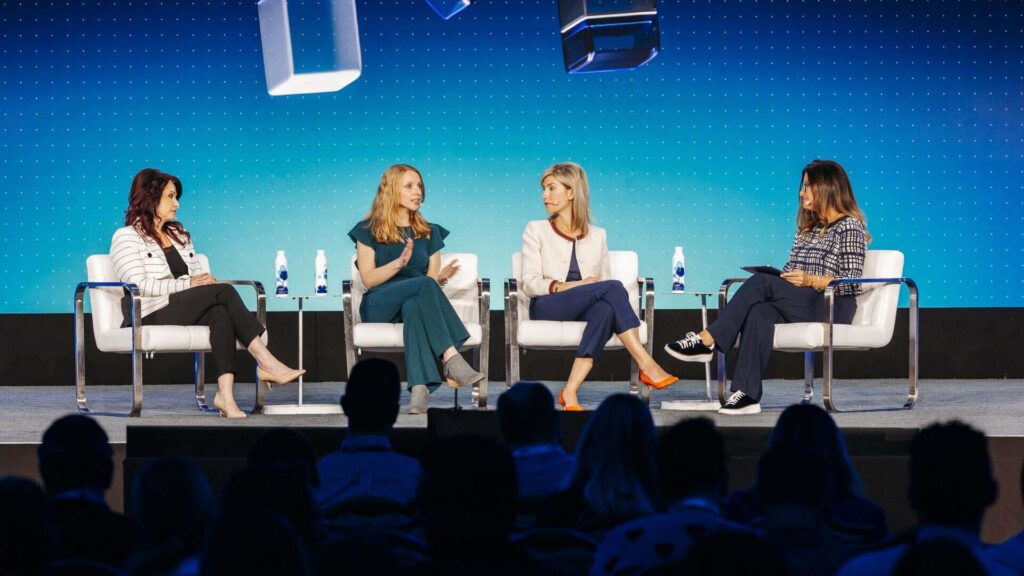
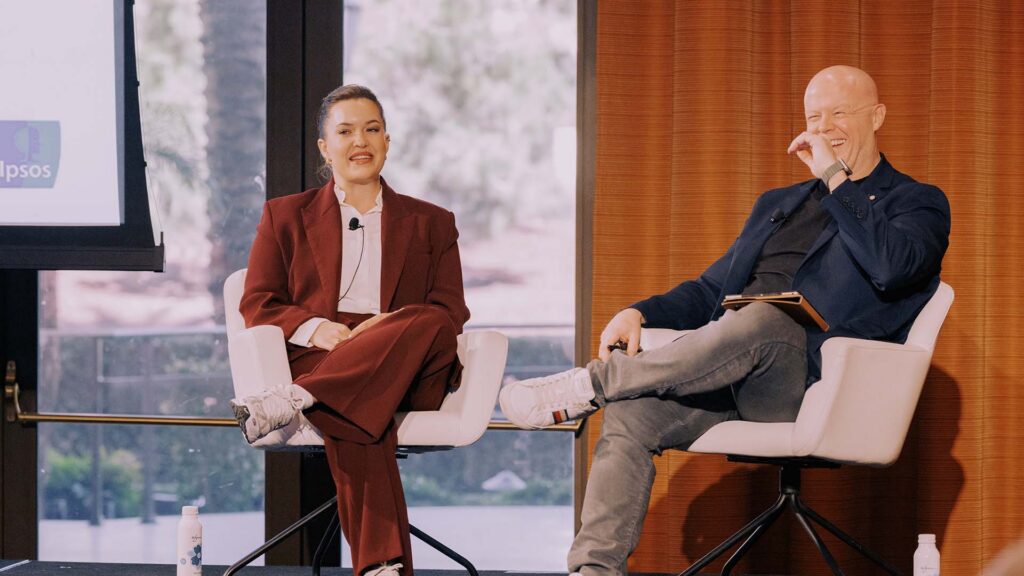
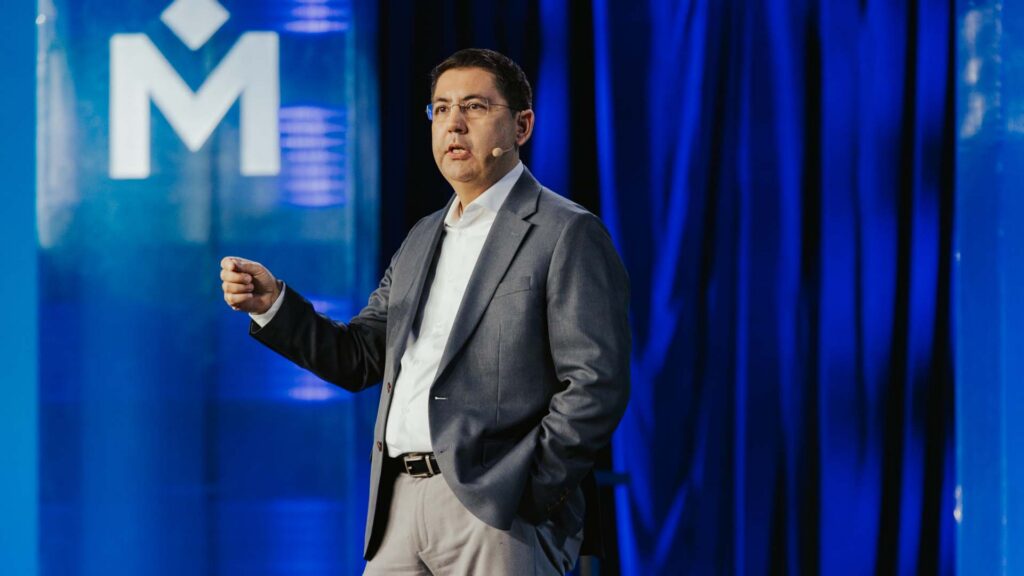
Jamie Thorpe: [00:00:00] Good morning. My name is Jamie Thorpe. I’m CXO of Ipsos in the UK. And we’ve got a really great session, really great story for you today. And I’m joined by Laura, who will introduce herself shortly. But I’m just gonna give you a bit of a an intro, bit of a rundown of what we’re gonna, what we’re gonna cover and how we’re gonna cover it.
It’s great to see so many of you, I’ve been, I’ve done so many of these Medallia experience events, and they just keep getting better and better, and. I keep coming back and we keep coming back. And the reason we wanna do it is we want to tell the story of where we’re delivering CX programs and where we’re seeing people take, as we say, tangible results, making something really practically happen within the organization.
That’s what we wanna share with you today. Whenever I do these in the US I have to start with a disclaimer, and that is that I am English. Okay, British, sorry, British. But there’s a difference. But in case you haven’t wear that out. I’ll start with that. And it’s like the start of a joke.
You’ve got an Englishman and a German with you today, but that’ll be, it’ll be fine. Let’s get a couple of the ground rules from an English point of view [00:01:00] out of the way. The first thing is yes, we love tea. We genuinely love tea. Okay? It’s a national obsession. And if you throw in a biscuit, we’re absolutely anybody’s, right?
So that’s the first thing. In case you’re thinking it, we say, please thank you and sorry a lot. Sorry about that. And then the last thing is, no, I have no clue what’s going on with the Beckhams and actually nobody really cares. Okay. So I don’t know who’s falling out with who and been disowned and frankly, I don’t care.
So just get those outta the way in case they come out as questions. Okay. While we’re on the subject of questions as we go through today we are a nice, we’re all one, one group we’re a nice intimate group. If you’ve got questions, please feel free to ask. What I love is whenever we do this in the uk.
We say ask questions. If you go as we go and people say, oh yeah, I’ll definitely do that, and then they don’t. Because they’re too reserved and too polite. But when I’m in the US you guys don’t care. You’ll stop us mid flow, right? And ask a question and that’s great. I love that. If you’ve got a question or you wanna make a point, please do feel free to, to put your hand up and interject.
It’s really not a problem. We will [00:02:00] allow time at the end as well for q and a and we will be around afterwards as well, so that we are standing between you and your lunch now. So bear that in mind with your questions. But seriously, do take time to ask the questions if you wanna know more.
That’s the plan. Everybody happy with that? Good ’cause we haven’t got another one. Good. I am gonna sit down now and I’m gonna ask Laura to very kindly introduce herself.
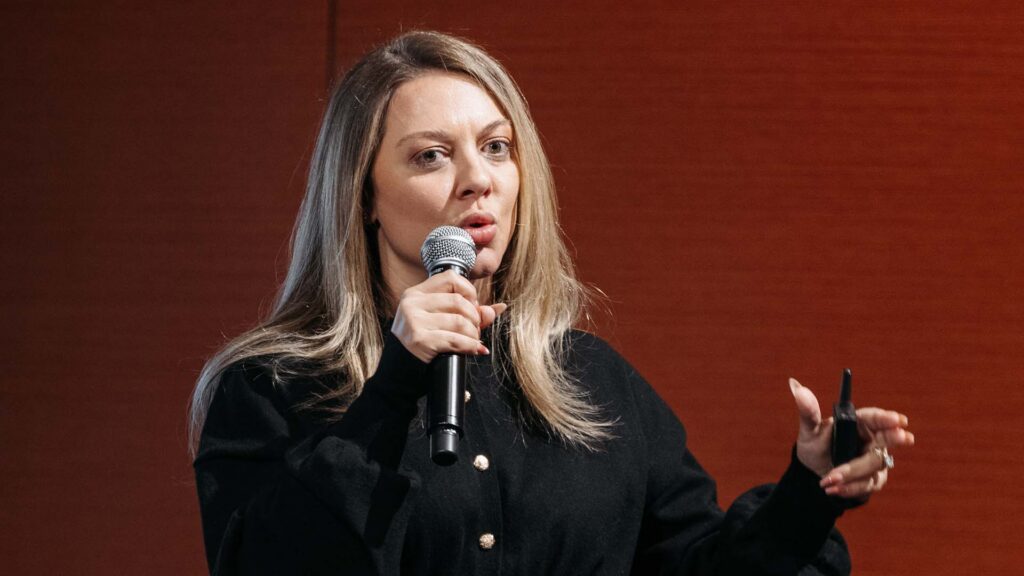
Laura Kortenbruck: Thank you, Jamie. Yes, my name is Laura. Jamie was mentioning already I’m German, but I actually flew the German cult and I’m living in Spain now.
Always in a good mood. The team is based in Copenhagen that I’m working with, so I always have to bring the warmth into the team’s heart. And I think you forgot one thing, Jamie.
Jamie Thorpe: What did I forget?
Laura Kortenbruck: You forget that in the daily work we have together, we are swearing a lot. I have to be honest.
So I’ve seen on those conferences that people are so using so nice language. I apologize already. Now it might be that some words are slipping through, but I hope everybody’s fine with that. I will do my best not to. I’ve been working in customer research [00:03:00] and insights for the past six years in international B2B companies.
And we have heard so much already about B2C and I’m super excited to share some B2B realities with you and hopefully some learnings.
Jamie Thorpe: Good. I like that. The swearing is fine. Okay. I hope won’t happen too much. We’ve gotta keep it real. Okay. So you all know the drill. Okay. So we can sit here and pretend the Laura doesn’t know what I’m gonna ask her.
She obviously does. So when she says, that’s a great question. I’m really glad that you asked that question, Jamie. I’ve seen it a few times here. I absolutely love it. Brilliant. We know Laura knows what we’re gonna ask. We are gonna go through a jour a journey and tell you a story. So again, like I say, focus on practical, focus on real.
Please do get engaged and please do get involved. You’ve introduced yourself. Could you just explain a little bit about the company
Laura Kortenbruck: For sure. So some of you have. Been, I guess yesterday to the sessions with sit. I’m super happy to have my manager here who also introduced the company already yesterday.
We are a global shipping and logistics company based in Copenhagen, and at the moment we are operating around 700 container vessels, but we are also having air freight [00:04:00] services in more than 90 countries. Warehouses all over the place and a lot of terminals. And we are working with customers like Amazon, home Depot, all the automotive companies you can name, but also retail companies like h and m.
So our work is really spanning across industries, and that’s one of the things that’s super exciting because it brings a lot of challenges and as long as one of the goods that a customer wants to get delivered fits on a boat or a truck or an air freight yeah. This customer can be a potential.
One of us, I wanted to add mask has been through a lot of changes through throughout the last years through a lot of transformation. So it has been 450 years, a shipping company, but the mission since a few years is now to actually connect the whole world and to deliver end to end. So when we talk end to end, it really means from the production place in China.
To the end consumer in the US or wherever you want us to deliver to. And that comes with a lot of challenges, but also some really great [00:05:00] opportunities and some excitements.
Jamie Thorpe: Very good. Who’s heard of Maersk? Who’s aware of Maersk? Okay. Interesting. Now I’ve said it. You’ll see it all the time on lorries.
Anytime you’re near anything that’s got a container, vessel or a ship, I guarantee you’ll see it all the time. I see it in films all the time.
Laura Kortenbruck: Yeah.
Jamie Thorpe: Yeah. And there’s a lot of that as well. So it is a massively impressive and it’s huge company. And I think Ada, you said yesterday in your session with Sid that.
20% of what we are wearing, touching, consuming, is likely to have come or been through Maersk at some point. So it is really fascinating and a huge organization. You’ve talked a bit about yourself, you talked a bit about Maersk. Can you just always wanna touch on the sort of size and shape of the team because most CX programs or most clients that we’re working with are trying to do an awful lot with a relatively small team, and you guys aren’t necessarily meant any different to that.
Laura Kortenbruck: So I think nowadays our. Organization is quite customer centric, so it’s difficult to say who works in CX and who doesn’t. I feel like everybody’s so excited to work in CX nowadays, [00:06:00] but I know you’re just talking about our team, yep. The team I’m sitting in we are around or we are 10 people located in Denmark besides me.
We are really trying to cover the global scope doing research products across the whole globe for different levels in the company. To be honest we of course couldn’t do that just with 10 people. So we have built a network where we have regional customer research partners and we also have some local ambassadors that have a different first job but that are equipped to, to share the insights, to come with research questions and are actually an extension of our team.
So that’s one of the lucky parts we’re in.
Jamie Thorpe: Okay, perfect. Extension of your team is a perfect and totally unplanned segue. So if we can talk about how we work together, this is very common place, certainly in the UK and Europe. This tri-party arrangement where we work together I mentioned it yesterday and what we do, how we work is that we bring.
Best of both worlds. So we’re bringing the class leading tech in Medallia with best in class expert services, [00:07:00] and we’re blending it all together as an extension of the team to make this work for Maersk, and it’s how we operate with many other clients. Again, a show of hands, if you are on the client side, how many people are aware or operate this ecosystem, or do you go directly to Medallia?
Quick show of hands, of people who operate this ecosystem. That is fascinating.
Audience Question 1: Wow.
Jamie Thorpe: If you were to do that in Europe, you would get. I reckon eight out of 10 people would put their hands up and say, this is how we operate. There’s no right or wrong answer. Everybody is different, but that is fascinating.
Not a single person. Put their hand up. So really interested to see how the difference in, in how we work. So Ipsos is the agency lead. We take point. We are Medallia accredited. We are running hundreds of Medallia programs globally, and we are research and insight specialists and CX specialists, and that’s how we work with Maersk.
So that’s how it operates, but how does it manifest for you?
Laura Kortenbruck: I think for us it’s a perfect combination of having a stable platform and a research partner that can also go beyond the platform. Jamie makes it look very easy. [00:08:00] I have to be honest, we’re not an easy client. We are very demanding on a day-to-day basis.
And our customers expect from us in enhanced customer experience every day, smoother deliveries, but also for us to think ahead. For example, this geopolitical times, we need to be a strong partner where customers know I can wake up in the morning and I know masks is by my sight in those difficult times.
And I expect the same from Ipsos and I expect the same from Medallia. I need a platform where I know things are running smooth and I know things that we have put in place are the next day still in the place, and I need an agency that the moment my stakeholders are screaming at me or I’m screaming at them, I need somebody that comes to me and or works together with me.
Tells me best practices in the industry and tells me how we can set up things in a very fast way, because that’s how it works in Maersk. We need fast results. We need to get things out fast. And I’m super happy that in the past years it has been a great success.
Jamie Thorpe: You talk about you touched on the needs and the shaping needs for business.
So what’s really interesting is CX is not a [00:09:00] project, it’s an evolution. And it takes a long time. I’ve been working in this space for 30 years now, and. I’m still amazed at the amount of people that think they can just turn on the CX program and that’s it. It’s done.
Everything’s fixed. Everything’s working. Clearly it’s not, nothing could be further from the truth, but maybe we could just touch on a few of the major milestones in the journey. And if I just pick up the first two and then ask you to take from there. So what’s really interesting here is we started working together in 2019 and we started with a quite traditional program, basic sort of CS SATs.
And there’s nothing, it was nothing wrong with it. It wasn’t fundamentally broken, but what. Is really interesting is when you get an organization like Merckx that has a clear passion for customer experience, how quickly that changed. So we don’t even run in it. A short while before we started making recommendations about how it should be moving to something that is quicker, is more operational, is getting further into the organization.
Which is why actually only a very short period after in, in 2020, we went and procured Medallia on behalf of Maersk and we implemented that [00:10:00] within Ipsos. So the journey is really interesting. That short period of time running something basic and then getting into it onto Medallia was really important.
And then you’ve had a few major milestones as you’ve gone and roadmaps and improved your program. Do you mind picking up on those?
Laura Kortenbruck: Yeah, I think one of the major milestones was definitely in 20 21, 20 22 when we launched the digital program. So we really started to listen to the customer experience on the digital platforms.
So on the website, on the app, on some of the booking platforms. We’re also having internally, I can tell you the logistics world, the B2B logistics world is still very far behind the B2C technical setups. So we know what Amazon nowadays can deliver. We know how much great platforms they’re out and for the logistics market, it took a while to, to get where they are currently are.
There’s still a huge gap between. The B2B logistics mark and the B2C, launching those digital programs really allowed us to bring everybody on the same page to say, Hey, these are some first grade milestones we had in the company on [00:11:00] platforms we have launched, but actually we are far away from meeting the expectations of our customers.
And as it has really brought teams together and also developers into the world of the customer. We had a few other milestones. So MES is a company that had over the last years, a lot of mergers and acquisitions, a lot of logistics companies outside the shipping world were bought. And of course we needed to make sure that these other brands and these other customer groups were also listened to.
So 2023 was a year where? It was a lot about data integration, making sure we get the right data points, make sure we align some of the listening tools that we have, some of the feedback measurements we have. Yeah, we couldn’t have done it without you guys because it was a major process. We had to put it in place.
And then 2024 came and we finally kicked off our transformation of our relationship surveys. And I guess we touch on this one in one of the latest.
Jamie Thorpe: We do. Yeah. We’ll cover that in later. And then also, you might notice that there’s a whole year missing, which is last year, and we’ll talk about that. And a few slides on because we’ve done something different there.[00:12:00]
I think the first, this is one of the takeaways that I would make sure that you capture or think about if you’re not already doing this, and this is the importance of a roadmap. So the statement that talks about where we have a maturity level within the organization and then a roadmap and a plan is so important.
And I know it sounds so basic, but the amount of organizations that can’t tell you what they’re planning to do in 6, 12, 18 months time is frightening. Having that roadmap in place to pick off what are the big items to make sure you’re driving engagement in a business is a huge thing that so many people frankly miss.
So it’s really important. To have that. When we talk about driving CX into the organization, we’re talking about trying to get engagement within the business. So that’s something that you’ve. You’ve done well on, and we’ve got the slide that shows you how the usage has has grown over time.
How important is this and one of the kind of things you’ve been doing in the organization to get people to, to use the platform?
Laura Kortenbruck: Yeah. I’m having mixed feelings when looking into this chart. We had some great developments. We have a [00:13:00] lot of people going into our Medallia platform right now. One of the things that we haven’t managed yet is to use all of the functionalities Medallia had.
So for us, it was super important the last year is to set the foundation. But right now, for example, we have a one size fits all dashboard. It’s not personalized yet, and we know there’s so much more to get out of it. So I definitely wanted to show you my target that I set for myself until end of the year.
So I know I wanna get to the plus 50,000 lock-ins every quarter, and we know we will, because right now with so many new functionalities in Medallia coming out, but also us wanting to spend time on. Tailoring the dashboards, personalizing the dashboards. We know it’ll drive even more stakeholders to us and even more people to logging in.
We also know we will not reach everybody in our company, and also some of the people will always stay outside Medallia. But those people logging in, they will drive the insights also throughout the organization. Also to the ones that have not used Medallia before. And maybe we’ll never do it.
Yeah. Let’s see.
Jamie Thorpe: Let’s move [00:14:00] and think about some of the areas that you’ve seen. Some challenges because to, as I said from the start, we need to be really honest here. We know there’s not a single CX program that is a hundred percent rosy that everything you know works perfectly all the time. But it’s important to face into the challenges, understand what they are, and think about how we overcome them.
So you’re happy to talk through some of the challenges that you’ve seen and clearly we’ll pivot to the good stuff as well, but because people might be facing a similar thing.
Laura Kortenbruck: Yeah. Of the things that I said to Jamie when he asked if we could do this talk, was not to share bullshit. I really wanted to talk truth.
And we are facing a lot of challenges. One of the biggest challenges is we definitely wanna move away from. Just running surveys, just running feedback programs. Everything that Sid has been talking about at stage is a hundred percent also true for us. We are already looking into data signals from customers, but it’s a challenge to get a hold of data.
We are having so many mergers and physicians, so much data sitting in silos and so little resources to actually get access to the data and make sense of some [00:15:00] of the data. We are always fighting the battle between finding a good balance of fighting for access and working with what we have. And this year we are definitely focusing on what we have and making the most out of it.
But of course there are some frustrations and challenges when knowing that we want to have so much more access to certain data points. We have leaders that are very skilled in the logistics world and they know so much about logistics and our customers and its amazing knowledge, but. The CX experience world and all of the feedback measurements that we are, for example, having, it’s very outside their scope.
And we need to make this tangible for them. We need to make sure they understand the projects we wanna launch. It brings value and it brings value for them. And it’s, we need to bring something to them that they can also easy sell to the board above. So we have made some learnings that. We need to make it even easier for them to understand our projects we’re running.
We need to make sure they really understand the value and we need to give them options because they often felt I feel like in the [00:16:00] past, a bit left out of these decisions. And by giving them different proposals and showing them the pro and cons, we have been able to get faster approvals of projects and move ahead with some of them and get the buy-in that we actually needed.
And I think the last one is. Internal politics and choosing your own bot battles. We have departments chasing us to work with us, and then we also have departments that are actually running away from us. So we have departments that they’re scared to g give us their data. They’re scared of the outcomes, they’re scared of the change that is coming, and they need to learn about the value we can provide and that would, we can be a partner function that enables them to work on behalf of the customer, but we have also learned to choose our battle.
If it takes too much time to chase somebody, then let’s focus on the allies we already have and let’s focus on the people that actually want to work with us and are actually chasing us on a daily basis.
Jamie Thorpe: You talk about the challenges, you talk about the different people in the organization pick your battles.
You’ve gotta make sure that this is operating on the front line on a regular basis, but also it goes all the way up to strategic direction and [00:17:00] linking into what the business is planning to do from a customer point of view. Do you mind just picking out how this works for you?
Laura Kortenbruck: Yeah. First of all, I’m not running all of this my own.
We have amazing colleagues. We have amazing teams running all of that together. And maybe let me start on the top. So not all of these programs are in Medallia yet, or some of them will also not come into Medallia, but we’re trying to bring more data together to have a holistic picture of the customer when it comes to the strategic direction.
We have something that’s called the customer council. It’s a group of senior. Decision makers from the most important companies across the world that are coming together on a regular basis with our management board and top leaders in the company. We know all of these programs you’re seeing here. They are bringing a lot of value.
They’re bringing a lot of data, they’re bringing a lot of stories, but in the end, it cannot replace the one-to-one interaction between management board. The customer, and we think it’s super important that they get those stories firsthand. And also when those customers bring some of the stories, management board is coming back [00:18:00] to us and asking us to double click into that.
Our customers really make sure our top leaders are walking in their shoes. We are like many others, we’re running, of course, brand and reputation studies across the markets, and we’re having a lot of strategic projects that are upcoming. So last year, for example, we ran a lot of churn studies a lot of studies to unpack key buying barriers.
We are of course, also working on predictive analytics, trying to predict churn, trying to predict the customer lifetime span. Looking into those other levels, one of the things we’re running is the relationship program. Yeah. Of course. Measuring NPS, some ad hoc research at site whenever needed. And then on the real time feedback side, we are having some online touch points on the digital sites, on our application, our website, but we also have some offline things we’re measuring on the customer service side and also on the onboarding experience.
Jamie Thorpe: I’m gonna pick out two things that you’ve mentioned there, if that’s okay. The first is the customer council. I, there I see mixed prevalence of customer councils in organizations. How many people have a customer [00:19:00] council? Similar, where what Laura’s explained happens within the organization.
Two, three. Again. That’s amazing. It’s really low numbers. We, it’s great that you guys are doing it, but the power of doing that and having that, if you can encourage your organization to do it, something that works for you, works well for you guys. It’s, it is amazing, isn’t it? When you see it, people, it’s frightening that people don’t do it When you think of the value that it can deliver.
So customer councils is something I would recommend as a, as an actions takeaway. The other thing I wanna pick up on is you keep talking about stories, and that’s really important because we’re all drowning. Data. But you guys focus a lot on how the stories make a difference in the business.
Laura Kortenbruck: Yeah, definitely.
And that’s why I also think the customer council works very well. So our leadership teams, of course, they get our insights reports, they get access to the data they want. We’re trying to tailor it as much as we can to top leaders. We know some of them are more data focused than others, but in the end it’s often the reiteration from the customer itself that brings it to life.
So we had a lot of [00:20:00] those customer council events where senior decision makers came back and said. The customer said exactly what you reported to me. Of course, you always have to take it a bit consciously of knowing You cannot invite all of the customers. You cannot represent all of the customer groups.
Yeah. I think we wouldn’t be able to do it just with Pure data. It’s important to let people still speak with people, make tell the
Jamie Thorpe: stories
Laura Kortenbruck: that Yeah. Yeah. Decisions.
Jamie Thorpe: And again, it was just something that was mentioned yesterday about being in the business of action, not just insights. And I think that’s something that, that these guys do a lot and we help bring it to life to make a big impact in the business.
And then of course, the reach. Really important. And on this next slide, we’re showing the sort of volumes of where the program goes to. Obviously in a more than a hundred countries, it’s amazing, but when you think about the contacts, and some people might look and think, actually that’s not a huge amount of contacts, but you’ve gotta remember some of these people are running multimillion, billion organizations.
So the value of this is the difference sometimes in B2B. The audience of. One, the importance of getting to as many people as you can is critical when we’re trying to [00:21:00] drive that experience. So the numbers, you’re pleased with the numbers?
Laura Kortenbruck: I am. I’m very pleased with the 20, 25 numbers. And these are just the numbers that we actually ran in our team in the headquarter function.
We know there’s also a lot of things run on the regional level and also on some local levels. Yeah, as Jamie said, of course we’re all being challenged with the response rates and we are, we’re seeing struggles. We also see the other side. So some of the service we have launched last year, we started having some random selections and not inviting everybody anymore.
And we actually received from a lot of sales colleague the request of including their contacts because their senior decision makers were asking for it. They wanted to share their feedback with us. They wanted to be heard and seen. And I think last year we listened to many of those contacts being, making very important decisions in those companies.
Yeah.
Jamie Thorpe: You’ve got some moments of pride on the next slide, and I love, I’ll stop talking and have you talk through these. The application in the real world is the, obviously the one that, and you’ll come to that. So please, would you mind?
Laura Kortenbruck: Yes. We were doing a methodology [00:22:00] update on our NPS program.
I’m not sure. Yeah. Maybe we can also check who’s measuring NPS in this, in your companies? I’m not seeing all hands up. That’s interesting. Okay. I need to pick the ones out that haven’t put the hands up in our company. It’s a WHO number, and I guess it’s in many of your companies. Our company has grown a lot.
We had so many merchants, neck physicians. We have new customer groups that we didn’t have 10 years ago, but our methodology didn’t change in the same pace, and this was because people really wanted to keep things steady. People. Saw the amazing development we had in NPS in, in other KPIs that we were able to correlate with and people were scared of a change.
They didn’t understand, okay, if you change the methodology, how much is NPS dropping? How do we, what do we tell the advisory board? What do we tell some of our external partners, we actually went to with those numbers and these development stories, and people were really a bit shaken up by us saying, we wanna change something.
So what [00:23:00] we did is we stopped waiting for permission and we ran some hidden tests in the back together with you guys. So we tried to understand the new customer groups that we will invite. What’s the impact of, IM like including them into our NPS surveys, but also what’s the value that those people being included can actually bring.
And by showing our management board the value and the insights that we got from these customer groups, it completely changed their mind. We had some very small drops in NPS. It wasn’t big. The management board really in the end understood the value instead of the drops, and was very much focusing on activating those insights we gained on customer groups we wanna grow with.
So that was a huge change. And now we are actually getting chased to bring out more insights on customer groups we never interviewed before. And that’s super exciting. Yeah. So
Jamie Thorpe: the first one is be bold, make the change and link it back to the value.
Laura Kortenbruck: Exactly. Don’t wait always for permission.
Jamie Thorpe: Yeah. Or surprise.
Laura Kortenbruck: Show the values. Yeah. The second one, I know my manager already touched on it yesterday, on stage last year. Also this year, the geopolitical situation for [00:24:00] our customers is terrifying. A lot of customers are shaken. Our industry didn’t know how to deal with all of the tariff situation, and there were a lot of narratives in our company on how to deal with customers and a lot of different narratives.
So sales saying customers want on a daily basis, information, customer servicing, their contacts they talk to, they’re overwhelmed with the amount of information we send. There were a lot of narratives out there. I know Sid was mentioning we should move away from having so many surveys and move more into having data points on customers here.
In this scenario, we were able with a very simple survey to fix a lot of myth and bring a lot of clarity in our own organization. So in a very small time we actually, with Ipsos together, launched some service to our customers on the turf situation and we asked them about what do you wanna know from us?
When it comes to those tariffs, like how often do you want to get some information? What do you expect from your sales reps and what do you expect from Maersk as a partner in the logistics world? And the answers were, they [00:25:00] were different on the customer groups, but they were very clear. They really wanted Maers to be by their side.
They really wanted us to listen to their own, to their problems. And this was a bit two folded. It was on the company side, but it was also on the contact side of those logistics managers in these big companies. Their bony were related to it. They were scared of losing their job because such big cost increases were expected and they still wanted to ask to pick up the phone, call them and make sure we are by their site.
They wanted to wake up in the morning and know, I’m not alone in this. May ask is here, and we are listening to them. We actually have seen a lot of competitors that went silent, and I think the biggest win here was that. In our company, we were aligned on the narrative. We were aligned what our customers want.
Maybe we didn’t have more information than our competitors, but we at least showed up and we were in this battle together with our customers, and we got. Lots and lots of positive feedback of how we manage this crisis actually together.
Jamie Thorpe: And then the third,
Laura Kortenbruck: I’m not sure who’s measuring a lot of sales touchpoints, but sales is [00:26:00] always one of those stakeholders that can be challenging.
We have an amazing sales organization. They’re very close to our customers. They know a lot and we are making sure that also what comes from them is listened to. They don’t know everything. And of course the feedback that goes to them from customers is also biased, and they don’t have all of the signals from customers that we can actually measure.
So again, here we needed to prove a bit our value. We started with some very small size pilots doing some real-time feedback, listening on opportunities that were won or that were also lost. And we were able to show the value in many of those pilots to the sets organization. Yeah. Now it’s the other way around.
They’re chasing us to actually launch that on a scale and that’s amazing.
Jamie Thorpe: Very good. We’ve been running the program for five years and we decided that it was a good point to just everyone stop. Everyone stop. Let’s just take it. Let’s, as we would say in the uk, let’s put our foot on the ball.
Everybody stop, take a step back and let’s have a look at where we are. So we did that and CX leaders and progressive brands are doing that because [00:27:00] people get so caught up in the day to day of running programs. They rarely stop and take a look back. So we did an audit of the program last year.
So that gives us an opportunity to look at the gaps. Think about where we are at the moment. Benchmark against best in Class cx. And importantly start to map that activity as you go forward, which is why 2024 was missing. Off of the earlier slide. One of the things that we do as part of this as well, is we speak to senior stakeholders and we spoke to 60 senior stakeholders to get their views of the world, what they want from the CX program.
And the engagement was fantastic. And what we really found out in doing that is that these people actually just wanna be listened to. And again, you just don’t, it’s such an obvious thing, but people are so caught up in the, in their day to day, they don’t. Take that step back. And so we were able to do that.
Look at the benchmarks, bring our expertise to the fore, and we found some interesting findings in our 2025 gap analysis.
Laura Kortenbruck: Yeah. Before we go into the findings, I wanted to add, [00:28:00] our department was quite clear that we know all of the gaps and we were quite certain that we just have to do this exercise to get everybody on the same page, have to say, we didn’t know about all of the gaps.
It was an amazing exercise because. We had planned to maybe interview 20 senior stakeholders, make sure everybody gets on the same page when it comes to what gaps exist, which ones do we have to close the fastest. And of course also get budget for running these projects. And in the end, we had a lot of senior stakeholders knocking on our door saying.
Why am I getting not interviewed? We thought it would be the other way around. We thought people would say, why do you waste my time? But it was completely opposite. People were knocking on our door saying, I wanna be part of that. I have an opinion. I have needs. I want more customer feedback. I want more customer insights.
And yeah, we ended up with almost six, I think it was around 60 interviews that we did in total. Super impressive number. And yeah, you were mentioning. Mentioning it. We tried not to look into technicalities because [00:29:00] our department also knowing about Medallia functionalities or what’s out there also tends to go always into these functionalities thinking, okay, we need X, Y, Z to be implemented by Q1.
But we actually now looked really into the needs of our stakeholders, and we found those three top ones. People definitely need to have easier access to our customer feedback. One of the initiatives this year is to bring Salesforce and Medallia together and to have an integration. We know we have a lot of sales rep out there that need to go to plenty of customers on a daily basis, and they use Salesforce as their go-to tool, but we do not have the feedback in there yet.
We have some linkages to Medallia, but we are not making it easy right now for an account manager to really see all of the feedback in one view. We also found out that we have to be better at tailoring certain dashboards. We knew that it’s one of the topics we wanted to tackle, but we didn’t know how big it is, and by getting a lot of the senior.
Stakeholders feedback. They were actually saying, I also wanna [00:30:00] go into Medallia. But right now it’s just all of those metrics and all of this stuff is just too granular for me. I need more high level views. And it’s one of those things that we thought we knew the priority, but actually we didn’t.
So now we found out we have to pay attention to that in, in 2026. We just put AI a bit on the bottom. We know AI will help a lot, but it will not solve all of the problems, but it will definitely help us to simplify the access to customer feedback. And then the second one was we knew a lot of teams are running their own surveys or trying to stitch together data points.
We didn’t know how big it was. We didn’t know how many people tried to, also very incompliant did things off our radar. I think you gave them confidence to speak openly to you because you were giving them this. Yeah, the feeling that we are coming with the solution soon and the solution is we need to enable more focal points to actually self-service functionalities.
We are right now moving away from the ad hoc functionality of Medallia. We’re making use now of Agile. Agile is so much more intuitive. People [00:31:00] love using it. People are very happy to move away from the ad hoc setup, and we are creating a bit of a community that can share best practices. Make sure that questions are getting answered on the tool, and we are now having those focal points installed across the business so that not completely un knowledged people are running those surveys, but people that have a broad understanding and also know whom to contact in the center functions in case.
In case they need some help here. And then the next one, I think it’s super exciting also for you guys because we wanna run more internal campaigns together internally. We know that people know about the importance of customer centricity. Everybody knows our mission, everybody knows the customers and center.
But some of the things that are so obvious for us and our department, we have to bring it even more often to the light. And reiterate also on it. We definitely wanna run internal campaigns on the insights we gather. Past insights, upcoming insights, Medallia functionalities, and then we are planning to have a company-wide customer day.
Our company loves to have such days, so we have a technology [00:32:00] day, we had an AI day. We have a wild amount of days where people focus on a specific topic. We never really had a customer day, and now we are planning actually with some of our biggest customers to have such a day to bring the customer’s daily life with us and also their pain points into a company-wide yeah, campaign and day where people can actually feel what customers are going through.
This is super helpful for teams that are working, for example, in the technology side and never get into contact with a customer and never have the opportunity to speak to them because now we are getting those customers in those, in the different locations across the world in the headquarters of Mask and make them tangible.
I hope they don’t touch those people, but I hope they bring it close to them. Yeah.
Jamie Thorpe: I’m not sure that one translated, but,
Laura Kortenbruck: and we’ll course hope to see some Medallia and if such representative there.
Jamie Thorpe: Absolutely. Yeah. We’ll be there. I’m gonna say. Massive thank you to Laura for sharing. There’s some big meaty subjects in here that we’ve covered at relatively high level.
Clearly we’d be happy to talk to them a little [00:33:00] bit more. If you’ve got any more then let us know. And actually that gives me an opportunity to just put always a questionable picture of me and a wonderful picture of you, Laura, on, on the screen to say if you want to connect with us, then please do, but I will ask Laura to just before we finish, before we wrap, and to see if there’s any questions from you guys just to.
To share hints and tips or anything that you would summarize? From the session today,
Laura Kortenbruck: I was attending a lot of great sessions and there were a lot of great tips and hints. I actually wrote down three, three topics for me for this year. So we took some learnings from the last years and it’s definitely to be bold.
Don’t wait for people to give you permission if you are able to pilot some things. And if you believe in a certain research project. Run it on a small scale, show the value of it, and then scale it up. Because these things, they make a tangible for your leaders to take decisions. And we have gotten so much buy-in into things we piloted on a small scale that on a paper, on a memo we would have never gotten to buy-in.
So right now we are quite bold and we are running things on our [00:34:00] own, and we are not waiting for the perfect setup anymore. Then the second one is be definitely the best of your customers. In the end, you always have to remember they are paying your salary. They are paying the salary of the whole company.
They are making your company run. And we are sometimes in a department that is seen a bit as annoying, I think because we are making people feel the pain point of the customer. When a customer has frustration, share that frustration with the organization because the moment your stakeholders feel the pain, feel the frustration themself, they will also act on that.
And we always have to remind each other on that to not go the easy route, but to be sure we represent the customer that cannot be in the room when you are having these discussions. And I think the last one is definitely. Story over data. So you mentioned that already before you launch a new research project, before you launch new touchpoints, before you spend so much time on new data points, really think about have you activated the data you already have access to?
Have you activated that in a story? We know that it’s [00:35:00] people that are taking decisions, it’s not data, and our leaders are getting overwhelmed on a daily basis with all of those data that is accessible to them. What sticks with them is the story and what really makes them act is the stories that you base.
Of course, on top of the data, it’s definitely be bold, be the ambassador and stories over data.
Jamie Thorpe: Very good. Thank you. And I’ll just very quickly share a couple that I’ve got on top of that, which is the importance of educating colleagues, engagement, taking people on the journey, the fact that it really does take a village, bringing experts together in their swim lanes really is a big game changer.
And then third, that audit, take the time to step back and look. And see what you’re doing. So hopefully we’ve delivered our promise of, practical points when delivering your CX programs. We’re happy to take any questions. Nobody interjected on the way through, but if you’ve got any questions, are there any questions?
Audience Question 1: Thanks for this presentation. Red Story. I really loved it. It’s gonna be very detailed now. The one thing you touched on was this integration Salesforce, so here, CRM [00:36:00] and Medallia. Can you talk a little bit more how that looks for where you ended with that? Because there’s always this whole debate of how much data from medal do you really want to bring and should sit in CM or not?
Laura Kortenbruck: Yeah.
Audience Question 1: Or what other ways to solve to make it available, to your point where. People are and where they actually need the information.
Laura Kortenbruck: Yeah. And we are right now actually in those debates, so the Salesforce and medal integration was approved for this year to come out. One of the biggest winnings we wanna have from there is we at least wanna make feedback from certain customers visible.
So we right now, we are not thinking of projecting everything into the Salesforce view, but to at least. Post a link to the full Medallia feedback story on a certain customer, but also make it visible that the feedback exists and this is what’s missing right now. So a lot of the account owners, they’re already super proactive.
They go into Medallia but they’re telling us it takes me some time to [00:37:00] actually see if feedback exists from this contact and would be so much more helpful if at least there is a link telling me, yes it exists. Click here to see the full picture. We don’t only wanna use it. The, this integration to display feedback, but we also wanna make sure we are able to automate some of the triggers.
So if a certain event is reached, we can trigger some surveys and we wanna make sure that we can have a bit better streamlined closing the feed feedback like the inner feedback loop set up right now, a lot of that is managed in local ex Excel files, and we do not have on a global level, a good overview of who’s really following up with which customer.
So that’s one of the things we also wanna bring, have the connection there to understand this is the account owner for this account. So perfect. We’re sending him a reminder because it seems in Medallia that he hasn’t followed up with his customer and according to our standards, he should have already two days ago, for example.
Jamie Thorpe: The only thing I would add to that is just to map out. Where those touch points are. I’ve seen so many times people create these Integra [00:38:00] integrations and they just plug it together and everything flow and it just is not the good way to go. So where does it need to be? Where, who’s gonna act? Who’s gonna close the loop?
Where? ’cause otherwise you just create confusion. Yeah, hopefully that helps, hopefully answers this question. Thank you for taking the time. Thank you for listening. Enjoy your lunch. Enjoy your rest of your time in Vegas and a massive thank you to Laura.