Shelby Patru: [00:00:00] Thank you for joining us. My name is Shelby. This is Zizhen. We’re gonna be talking to you today about the hidden audio clues that you may not be thinking about when you’re trying to understand why a customer is having a negative experience with your company or brand. So we’re gonna discuss what these clues are.
We’re gonna discuss how you can actually see them in the Medallia platform today. And then we’re gonna talk about why they’re important for you to consider being transferred around, sitting through long holds of silence, feeling like no one is listening to you. All that’s doing is driving up your own frustration and potentially it’s putting your future loyalty to that company or brand at risk.
Your call audio Inside Medallia holds all of this information already. You just need a way to be able to see it. So what are the audio clues that we’re gonna talk about today? We’ve all experienced a conversation transfer just like we saw in the video. You think you’re talking to the right person, but then you realize you’re in the wrong department [00:01:00] or you’re talking to the wrong person and they have to transfer you in order for you to get your question answered.
Secondly, not only do long periods of silence make you question if your own phone is working, but it can cause even more frustration and confusion since you don’t know if the agent is actually still there or if they’re working on a solution for you. And finally. Overtalk within a conversation not only delays the resolution further, but it can lead to heightened emotions, and that often makes it feel like an argument that’s going back and forth without any resolution in sight.
Both Gartner and Forrester have found that when you combine transfers, long silences and overtalk, it’s not just operational noise. It’s actually all indicators of higher customer friction, and that friction will directly erode customer loyalty and your agent’s efficiency from an analysis perspective.
When you combine all these components together, you can create an [00:02:00] overall customer effort score. Gartner has found is a stronger predictor of customer loyalty than just your traditional customer satisfaction score alone. Gartner found that with a customer effort score, it’s actually 40% more predictive of long-term loyalty than your basic CSAT metric.
So when all these audio clues and all these friction points occur, they end up triggering a chain reaction that hits the bottom line, increasing operational costs. Also potentially decreasing future customer loyalty and revenue. So we’re gonna talk about transitioning away from just measuring the calls in total and actually optimizing the conversational flow.
So we’re gonna go a little bit deeper into each of these audio clues to better understand what they are, how we could start thinking about them in the context of reducing effort for our customers. So we’re gonna start with transfers. Forbes research shows us that eight out of 10 customers say that they’ll actually [00:03:00] switch to another company after only one bad experience.
And when asked to say which experience is most offensive to them. It’s being transferred around multiple times. Not only do these unnecessary transfers result in a lack of loyalty, but they also drive up frustration for your customers. Transfers cause that customer to repeat themselves and have their issue talked about and reviewed multiple times.
All while trying to navigate your phone system and a wide population of agents who may or may not be able to help. Oftentimes transfers are actually a resolved of the way that your contact center is set up. So how many times have you called a contact center and said and heard, press one to speak to this department, or press two to speak to that department.
In the contact center, this is what we call an IVR or an interactive voice response. But if the iiv are not set up correctly, we end up frustrating the customer even more than they already [00:04:00] are. So think about this. Let’s say I see a double charge on my credit card. I call my credit card company. The IVR says, press one for technical support, press two for account services.
I choose two account services. I get an agent on the phone and they say, I only handle general account questions. You actually need to talk to billing. I get a billing agent on the phone and they say, well, it’s a double charge. Only my manager can take care of that. So now I’ve talked to three departments and three different agents all about the same issue.
From an analysis standpoint, it doesn’t look terrible. Agents are picking up the phone quickly. They’re transferring me pretty efficiently between departments. The call system only shows a couple transfers, but from my perspective as a customer, I’ve had to explain my issue three times to solve what seems to be a simple problem, which is further driving up my frustration and my overall experience with the bank.
Now, in some cases, a call transfer could [00:05:00] be harmless. If I was calling to check on the status of a package, for example, I might not mind being transferred to another department ’cause there’s a low emotional investment with that type of transaction. As long as I get my tracking update, I’m good. But in the case of the double charge on my credit card, multiple transfers could risk that company’s reputation and erode my trust in them going further, it’s a highly emotional conversation.
So every time I have to repeat personal information, every second that I spend on the phone is not only killing my confidence in the brand, but possibly breaching my trust. Now let’s go on to that second clue, which is long periods of silence. So think about the last time you had to call into a contact center with a show of hands.
How many of you remember just sitting in silence or sitting on a long hold waiting for the agent to get back to you? Yes, a lot, probably all of us, we’ve all [00:06:00] had them. We all know how they feel and research into calls tells us that about a third of a call is just silence. So as you can imagine and as you’ve experienced, the more that silence stretches on, the more frustrated we become.
Call silence is a result of multiple issues. The agent may not be familiar with the problem. They may need to go do some research to resolve it, or the systems that they’re actually using to find the solution may be running slowly causing a delay. Instead of sitting in silence. Though agents can improve this experience in a number of different ways, so context center managers and coaches should really be encouraging boosting customer confidence through some additional agent skills to start with.
Agents could instead provide a running commentary of what they’re doing. So instead of sitting in silence, they could have told me, I’ve located your account. I’m opening your billing information. I see those double [00:07:00] charges that you were talking about. Forrester has found that customers actually feel more abandoned when they’re just sitting during dead air or long periods of silence.
There’s a psychological difference between actually being on hold and hearing that hold music or hearing those marketing messages versus just sitting and hearing dead air. Research tells us that if your agent’s task is going to take longer than 15 seconds to resolve, the agent should consider a more formalized hold instead of silence.
And finally, when it’s a lower risk or less emotional interaction. Agents can be encouraged to engage in small talk. So we’ve all experienced this. I’m sure an agent is working on our issue. They say, how’s your day been so far? What? What plans do you have coming up for the weekend? All very non-risky questions to say, but helps fill that silence while systems are loading.
By reducing this dead airtime, customers will not only feel like their issue’s being investigated, but their [00:08:00] trust in the brand may increase when they aren’t feeling like they’re all alone in tackling this problem. So finally, let’s talk about our last clue, which is conversational. Overtalk overtalk is when both the customer and the agent are speaking at the same time.
So sometimes this happens because the contact center technology itself isn’t working properly. There’s a delay in the phone line, which is causing the agent to begin speaking even before the customer has finished. Oftentimes, agents just aren’t trained on this specific style of active listening behavior, especially in these highly charged emotional conversations where empathy and understanding are critical.
So when you think back to our home alone example, in an already stressful situation, the last thing the customer wants is to feel like they aren’t being heard or that they’re being interrupted. We’ve found that just two instances of overtalk in a conversation is enough to increase customer frustration significantly higher than it [00:09:00] already was at the start of the call.
Constant overtalk throughout the conversation destroys that natural flow. It can have an operational impact as well because it’s increasing the overall duration or length of time that I spend on the phone and impacting my overall customer sentiment. Coaching agents to reduce overtalk can happen in a few different ways, so Gartner and Forrester have said that it’s more important to identify the intent behind the overtalk than just counting how many times it happens.
Agents should be coached at better active listening. So if both parties start speaking at the same time, the agent should be coached to immediately stop talking. Let the customer finish what they’re saying, wait for a beat or two of silence, and then say, sorry. Please continue so as to not feel interrupted.
Active listening as an actionable coaching behavior has been shown to be a high driver of customer satisfaction. So acknowledging the customer and encouraging them to continue the [00:10:00] conversation is always the best route. Now, oftentimes, overtalk happens because the customer is anxious about whether the agent is actually doing anything to help them.
So agents should use audio directions similar to what we talked about before, giving them guide rails for where they are in the process. Saying, I’m looking up your account now. It should be loading in just a few seconds. That can help give the customer a timeline to resolution and makes them less likely to interrupt or con, continue that overtalk.
Now, eliminating overtalk is likely impossible, but by recognizing the behavior. Then taking the steps to defer to the customer. Long term, we’ll be able to increase that satisfaction and overall brand loyalty. Now, we’ve talked about these three audio clues, so it’s time to see them in action inside the Medallia Experience Cloud.
I know we’re talking about a lot of very contact center specific items, but a lot of this is relevant to our CX practitioners as well. [00:11:00] Knowing why these clues are happening, and then being able to tie them to actual customer loyalty metrics and long-term outcomes is really key here. So I’m gonna pass it to Ian and have her walk us through it.
Zizhen Liu: Thanks, Shelby. We’ll start with drilling down into an interaction to visualize the three audio clues that Shelby just presented, silence, overtalk, and transfers. We’ll then deep dive into these metrics across interactions to identify agent coaching opportunities as well as problem areas associated with these metrics.
So we are also going to see customer effort and action and pinpoint the conversation topics there are driving effort up. All right, without further ado, let’s jump right in. We’re starting off at the most granular level, looking at an interaction from our customer. Emma Lee. She completed post-call Avior survey.
As you can see [00:12:00] here, we got her survey comment. This survey is coming from our MEC and mindful integration. Here we can see in Emma’s survey feedback. She called out that the process took long and there were long silences during the call where she wasn’t getting updates and she was hoping the agent would be more prepped for the conversation and show some empathy during the call.
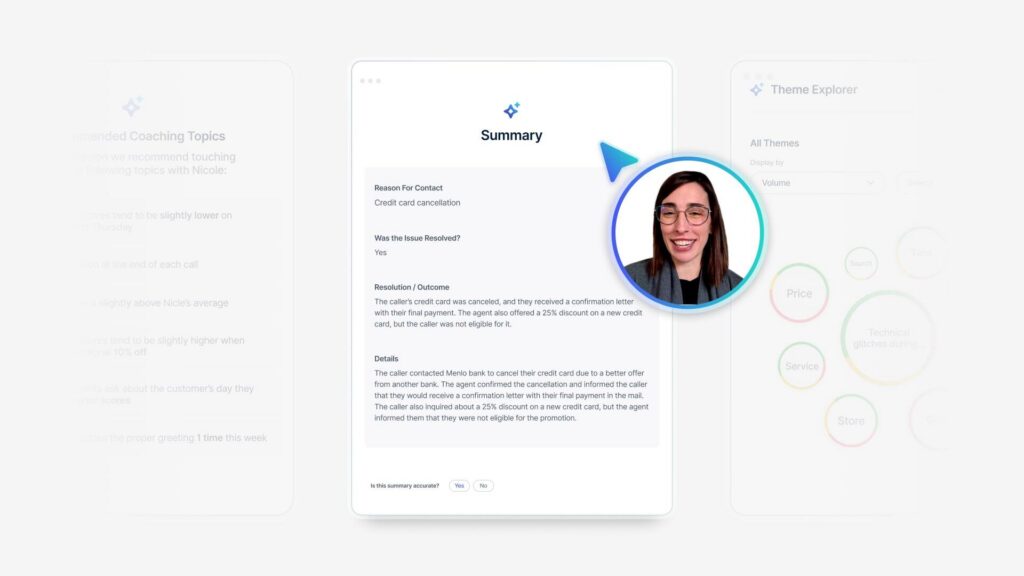
Down below here we have an AI generated summary of the conversation, which includes the primary reason for contact issue resolution. A more detailed overview of the back and forth discussion between the agents and the customer. Looking at the contact reason here, Emma was calling in for opening up an inheritance account.
Her issue was resolved at the end and underneath the summary, we have the media playback. The Medallia speech product collect raw audios from different CC systems such as NICE inContact five nine. [00:13:00] Genesis, et cetera, and transcribe these audio files into text for in-depth analysis. And the conversation map up here shows us the sentiment associated with each phrase, both from the customer and from the agents, as well as the acoustic events that happen during the conversation.
So what catches our eye right away in this event section is this long bar of silence. When hovering over, we can see the silence lasted for more than four minutes. Imagine that you or Emma on the call with the agent. This is a crazy amount of silence. You might be wondering, am I still connected? Is he helping another customer?
In the meantime, is he gonna transfer me again? ’cause he doesn’t know anything about the issue that I’m having. We can also visualize Overtalk here. In the same event section, when you hover over, you can see how long that overtalk incident lasted for. One cool thing about [00:14:00] this conversation map is that we could jump directly to any parts of the call by simply clicking on the bar.
So now let’s jump to where the silence took place. We’re gonna read the transcript at one minute Mark. We see the agents that is going to reveal the process and work on it. Then there’s a long silence, and at the five minute mark, that’s when Emma lost all her patients and she asked, are you still there?
And scrolling down, we see Emma getting more frustrated. She kept on complaining about. The loan process and she has a meeting starting in a few minutes. I’m scrolling further down. Um, she’s saying the whole thing took so long I wasn’t sure what was happening ’cause she didn’t get any updates from the agents.
This is absolutely a coaching opportunity where like Shelby has shared earlier, the agent could put Emma on an official hold [00:15:00] play the holding music instead of just that air. He could get better at setting up timing expectations with, uh, um, Emma at the beginning. Provide status updates while he’s processing her request.
Reassuring Emma that they’re still connected and he’s working through, um, the system to get a resolution for her. Now that we’ve seen silence and overtalk in the MAL platform, you might be wondering, where can I see transfer? Where’s the other metric that Shelby presented in her slides? Well, that lives down in this metadata section.
When Medallia speech collects audio files from different systems, we are also pulling all sorts of metadata associated with each interaction. And here we can see Emma’s call was transferred. Call transfer. Yes. And she got transferred twice before she was able to talk to the agents. Making it more frustrating experience.
We looked at silence [00:16:00] overtalk and transfers at the micro level. How do we understand them at scale and their impact on our business and our customer experience. For that, we’ll need an aggregated view. So now I’m gonna go ahead and move to the audio clue deep dive dashboard. On top of this page, we do have a little glossary that gives you a refresher of the different metrics that Shelby just walking us through.
Looking at transfers. I have 13.5% of calls that are transferred in the last month. The number is fluctuating and going up in the last week, like what Shelby has shared with us earlier, transfers is less about coaching an individual. It is more about structurally how we could effectively and accurately route customers to the right call queue so they don’t have to be bounced around by different departments and can get the help that they needed right away.
Looking at the call queues list here, I’m seeing transaction increase, fee [00:17:00] dispute and balance increase being the top ones having high above average transfer rate. And this is the information that I can bring to my CC team to help them improve call routing efficiency. For example, we could have more granular manual options for these categories.
So customers can speak to the right teams in their first call attempt. Scrolling further down here, uh, we’re also using TA to analyze the conversation topics that are driving transfer rate up with gene AI produced summaries. We don’t really have to read through the whole transcript or multiple transcripts to get to the pinpoints or the root cause.
The summary will kind of. Generates for me, and I can get an understanding of what our customers are frustrated about. So here we can see for account access, for example, customers encounter issues with setting up secure access codes, receiving verification texts, and getting locked out of their accounts.
[00:18:00] And when they contact us for these reasons, their calls tend to be transferred more often. Moving on to silence. Our average percent of silence for this month is 28.8, aligning with the 30% threshold that Shelby shared in her presentation, and we can see the silence is trending over time. The number itself, 28.8, doesn’t tell me much.
We recommend focusing more on the trend when you see a surge or a dip, right? That’s when you wanna investigate further. We actually had one customer recently, uh, found a surge in their percent silence overall, and they later found out that they had agents leaving the line open after customers hopped off to take a break, and which of course drove up the cost and the silence time.
With silence. We also recommend looking for outliers. They are individuals that you can work with to make sure they have lifestyle [00:19:00] time in their conversations. And with silence, it can be related to agent lack knowledge. It can also be related to the slow loading system or system glitches, so it’s taking longer for it to load.
For example, here we are highlighting the TA topics impacting silence, and what you see on the left hand side are the topics that are driving silence up and we’re seeing log in logout password registration. Which seems to be a very, very simple request, and we would expect most of our agents to be good at solving simple requests like this.
So highly possible. This can be related to system glitches or performance issues, and this would be very consumable information that I can pass along to my IT team to troubleshoot. Last but least, let’s take a look at Overtalk. Our speech engine tracks overtalk incidents separately from agents and customer, so we could see which speaker is cutting off the [00:20:00] other party more often.
Again, you can leverage a ranker report to identify outliers, um, that you could work with to reduce talk. We can also focus on the conversation topics. Where customers are overtalking agents a lot more. When customers are getting frustrated in the conversation, they’ll be less patient with the agents and they tend to interrupt the agent more often.
So that’s why these are drivers for a customer frustration, which you can pay attention to. As Shelby mentioned earlier, multiple transfers, high silence, high overtalk, all lead to increased customer efforts. So now let’s move on to. Customer Effort dashboard. So here as a CX Insights user, I’m interested in understanding the amount of effort customers took to interact with us, which interactions required high efforts and what are driving high efforts or speech and text analytics generate automate scores [00:21:00] that help you measure the customer efforts per interaction, and the gen AI powered insights.
Would help us get to the reasons behind the high efforts. At the top of this dashboard, we have a blurb that explains the automate score for high effort and how it is calculated. It measures a hundred percent of your interaction and calculates the percentage of interactions that required a significant amount of customer efforts.
A high effort is determined by waiting audio clues such as silence transfer overtalk. As well as TA topics that capture customer perception of hard efforts. For example, if a customer called in and complained about getting bounced around by different departments, that will be tagged by a TA topic and flagged as high efforts.
Looking at my key highlights here, I got 24% of my calls that required high effort from my customer, and we can see over the month. [00:22:00] This percentage is going up. And now I wanted to understand what are the drivers behind high efforts? Again, with K analytics running on my transcripts, I can easily get to the contact reasons that are associated with, uh, high efforts.
If you remember from our last example, I didn’t have to go through any. Transcripts or audios to get to the root causes. Similarly, here, I can easily click on the view summary button to see a summary of what is happening, taking transferring inheritance. As an example, customers are complaining about processing, taking long, and agents’ lack of knowledge.
Now, if I would like to drill down into, um, high effort interactions, I can scroll down to see them. Here we see our conversation from MLE again, which actually triggered a high effort alert and the relevant teams have been notified and they can follow up with Mr. Right away. Before I hand it over back to Shelby, I just wanted to [00:23:00] quickly call out that, um, the customer score effort score that you saw in the demo, and actually any auto scores that meta system generates are highly customizable.
We could adjust the waiting and we can adjust what elements. Your survey metric, your metadata, your topics, what goes into the score. So make sure you work with your Medallia team and we’ll have a score built just for you and your customer. Now I’m gonna hand over back to Shelby to talk about the cost associated with these auto clues.
Shelby Patru: So now that we’ve talked about what the audio clues are, now that we’ve seen them in action inside of Medallia’s Experience Cloud. What we really wanna look at now is figure out what we should be doing about these clues that we’ve discovered. So we’ve talked about customer effort and we’ve talked about how these clues increase that effort and potentially reduce that overall brand loyalty or increase churn.
But what we haven’t talked about is that there is a hard operational cost [00:24:00] with all of these clues. So in a large scale contact center. Reducing your call duration by as little as 10 seconds. By eliminating these long periods of silence, or a lot of unnecessary transfers can actually result in saving hundreds of thousands of dollars over the year.
Medallia’s own research identified that when customer frustration increases because of these clues, we see an average of an extra two minutes spent on the phone. Simply because they want to vent about the frustration they just experienced. So think about that over a contact center that has thousands or even millions of calls.
That is an a lot of extra time and a lot of extra cost that your company is taking on. And when you think about it, a call transfer is essentially paying for that same call, two, three, or even four times. Foresters told us that the likelihood to resolve a conversation the first time drops by up to 15.[00:25:00]
For every transfer we have to make, which is not only leading to higher rates of dissatisfaction, but could double or triple the cost of that conversation in total. So it’s important to note that silence overtalk and transfers are not just an annoyance. They are actively driving customer churn when you’re being transferred, when you’re forced to repeat information.
This is actually the number one complaint in CX surveys. This behavior tells your customer that your internal teams are not talking to each other, and that can erode that customer’s trust in the company’s overall reliability. And when you have those frequent periods of silence or overtalk, oftentimes the customer may think the agents are just untrained or unhelpful.
CX feedback tells us that when this happens, customers are three and a half times more likely to consider switching to a competitor. It’s not just the customers that are frustrated, right? Think about the agents themselves. Agent [00:26:00] satisfaction is important because they are the front lines and the voice of your company during these key interactions, high transfer rates are not only frustrating to the customers, but it’s demoralizing to the agent.
They fail to solve the issues that are being asked of them, and they have to now find the appropriate workflow or route to get that customer to the right agent. When there’s high levels of customer overtalk, which is often an indication of frustration, agents who have continuous conversations like this day in and day out are known to have higher burnout and increased turnover rates, which is just an extra cost for you as you train new agents continuously.
Then finally, those long periods of silence, especially driven by slow internal systems or broken processes, can lead to lower agent engagement and again, those higher attrition rates. To wrap everything up for us today, why is it important that we identify and understand all of these different clues? [00:27:00] So as we’ve talked about throughout the session.
Higher rates of transfers of silence of Overtalk can put your customer loyalty at risk and could potentially lead to churn or dissatisfaction long term. By focusing on each of these clues individually and using Medallia to identify them in conversations like Zein showed us, we can identify these patterns quickly.
Understand how best to improve that overall customer experience and reduce that customer effort before it becomes a bigger problem. If you wanna see any more of this in depth or go further into our contact center offerings, we do have a contact center booth up in the product hub upstairs, and we’d like to open it up for any other questions, comments, or conversation that anyone might have.
Audience Question 1: Is there, um, currently available or maybe in. In the future plan where I know you guys Medallia can detect like positive or negative emotion through the [00:28:00] conversation, right? And walked us through that like interaction journey and that journey, since we have that could be long depending on the conversation, right?
Is there like a much smaller or um, uh, view where we could see how the customers. Emotion progressed through the call. ’cause I think that would be a good way for us also to assess how our associates are handling these customers. ’cause customers may be coming in frustrated, they’re mad, so we got a high negative or high red emotion at the start.
But we want to finish that conversation with a green. Right. So, and if that conversation ends in red still, or it could be that they started neutral and then became red at the end, then that would be something like another area we could talk to that associate with. And also if we could expand that [00:29:00] from like a con, uh, conversational level to like a topic level now or to a team level, then we can have these conversations like, Hey, for this particular topic regarding double charge.
Customers are ending their conversation highly negative or highly angry. So may we should focus on that or some, something to that nature. So not sure if I’m making sense, but
Shelby Patru: No, you are. Yes you are.
Zizhen Liu: Just quick clarifying question, Ron, on, are you looking for emotions within the acoustic events or more text related emotions?
Audience Question 1: I’m not sure. That’s why I’m kind of like asking it. I guess it could work for both if it’s acoustic. Yeah, I think that would also be helpful. Um, I understand that transcripts might be based on. Certain negative words or positive. So I’m kind of curious if there’s anything in the pipeline or active for in Medallia for that.
Zizhen Liu: Yeah, so, uh, from a topic perspective, we do have compound topics, which I know a lot of you [00:30:00] guys might have in your system where you can control, um, a keyword, keyword, combination configured at the end of the conversation. And you can set a limit to be like the last 30 seconds or 10 seconds, or 10 phrases from.
Customer speaker. So I was thinking, um, you can have like a frustration topic or a negative sentiment topic created and limit that to the last portion of the call on the customer side to help gauge the sentiment. Um, so that’s like what we already have in our system today that you can leverage to do that.
From an acoustic model perspective, our product team has been looking at our engine that is running for speech and see what additional metrics we can populate. So today we have overtalk, we have silence and all sorts of metrics. Emotion, sentiment is definitely something that, that they’re looking into.
Audience Question 2: My name is Katrina Tan. I’m at Central Pacific Bank, which is a law, small, small local bank in Hawaii. [00:31:00] And um, one of the big things that shows up for us in our call center. Is, if you’ve ever been to Hawaii, uh, it’s considered very rude if you are unwilling or you cannot talk story or chit chat or do a little bit of small talk.
And that is very customary that you, you should engage with a bit of small talk and. Asking about like how was your day? And that kind of thing. Right. So it is considered rude to just jump straight into solutioning. So is there a way, you mentioned some of that sentiment and analytics. Is there a way to find out how much time someone might be engaging with some of that camaraderie building?
’cause we know folks get a little bit. They go for a while, right? Especially ’cause we have a lot of senior citizen customers who will call in, they call in, they wanna check their account balance and then talk about their kids and that kind of stuff. And it’s all very sweet because you know, they’re bored and we’re here.
Right? But [00:32:00] is there a way to measure that so we can provide guidance from our call centers to say, yes, you, this is some guidance of how long to talk story. And then please go ahead and solution.
Shelby Patru: I would say similar to how HIN was describing a compound topic where you would be looking for certain keywords or phrases, maybe to define a frustrating experience, to a positive experience.
You could use the same approach to identify those small talk markers and then compare that against the call duration that we’re gonna calculate off of the audio file that we get. So in aggregate, you could say, you know, when small talk is present in the conversation, the call duration is. X minutes longer, and then you could go deeper and just look at that one behavior of small talk and see on average by agent or by supervisor or by department who’s doing that and for how often to start the coaching efforts from there.
Awesome.
Audience Question 2: Thanks so much.
Shelby Patru: Yeah, absolutely.
Audience Question 3: I know that they had, [00:33:00] um, in this model it showed that the survey. Was taken, was linked directly to the call. Is there any ability for us to demo and say, Hey, people who gave us on a one to five scale, one’s had this percent over talk and this percent silence?
Shelby Patru: Mm-hmm.
Audience Question 3: Okay.
Shelby Patru: Yep. You can segment on anything that’s coming from a survey or anything from your metadata. Yep. I would venture to guess, I don’t have data to back this up, but I would venture to guess that if you’re seeing a lot of overtalk, you’re gonna see a lot of ones. You’re gonna see a lot of low csat, you’re gonna see a lot of low NPS.
They likely all correlate together, but you could segment all of that data by the survey response or the rating itself.
Audience Question 4: And then I had two capability questions. One for the speech processing. Is there any roadmap to bring it to more real time processing? Um, so you can do in the moment coaching or in the moment.
Next best actions. Yes,
Shelby Patru: there is a roadmap plan. I don’t have a date or a time to share, unfortunately.
Audience Question 4: And then question two, for the configurability for doing the automated scorecard. I [00:34:00] know that right now is built a lot on, on topics and it’s pretty binary with Yes, no, with all the Gen AI kind of being released.
Is there gonna be some more gen AI capability around the scoring?
Shelby Patru: There is. It’s gonna be built into our Agent Connect platform, which is kind of a manual QA platform that sits on top of the automated. Also on the roadmap, but also unfortunately no date that I can share yet. Thanks. Thanks everyone.