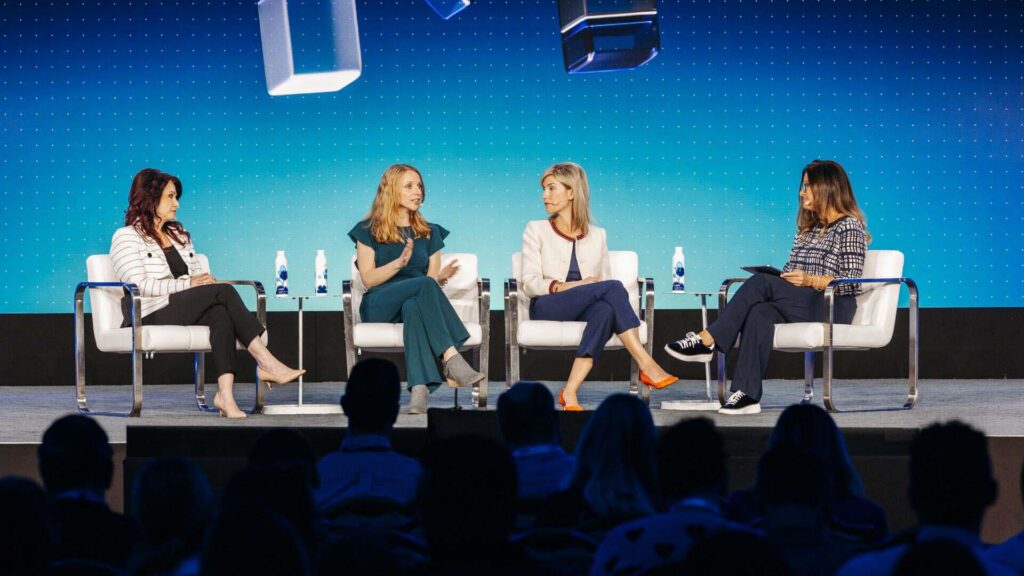
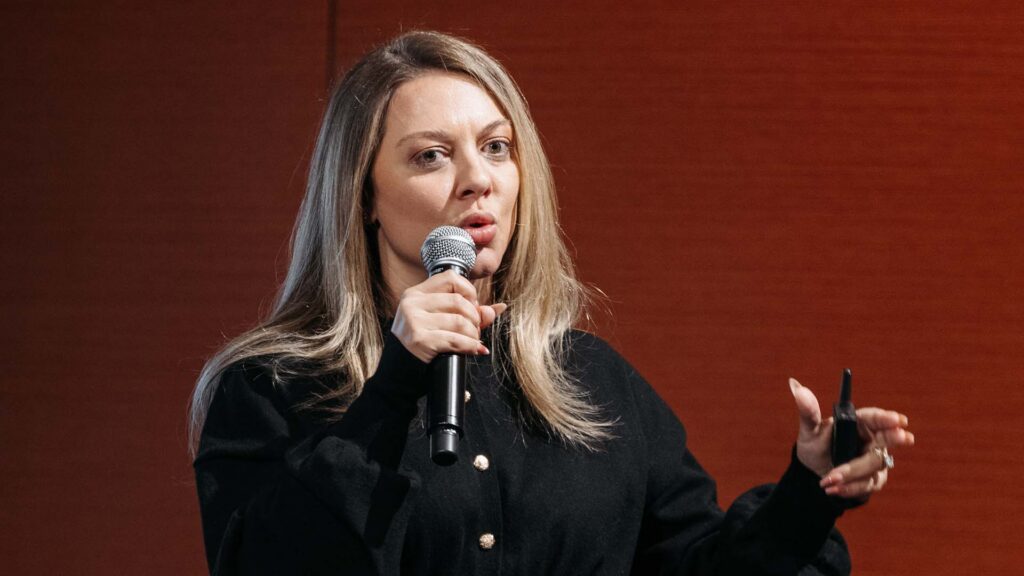
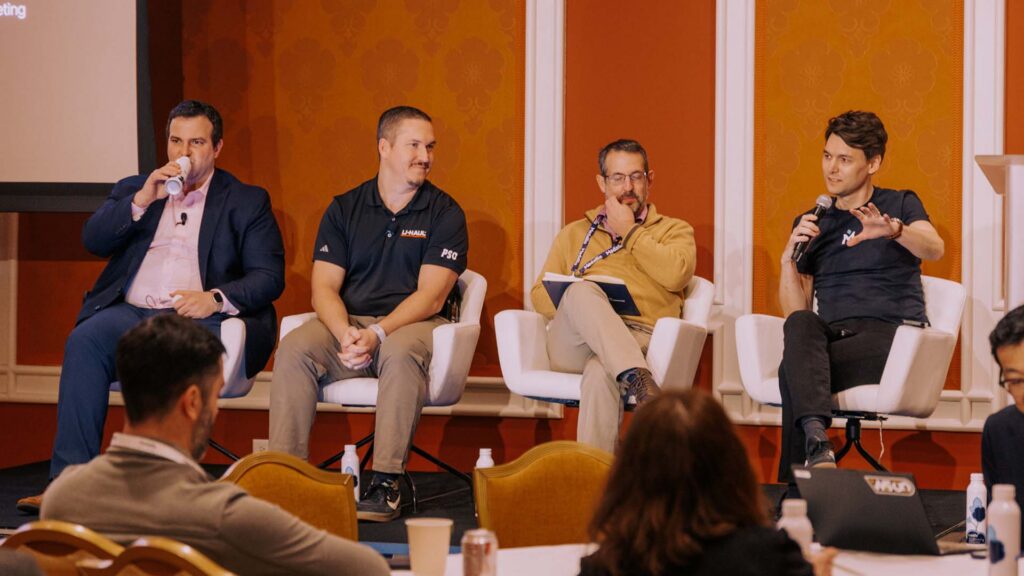
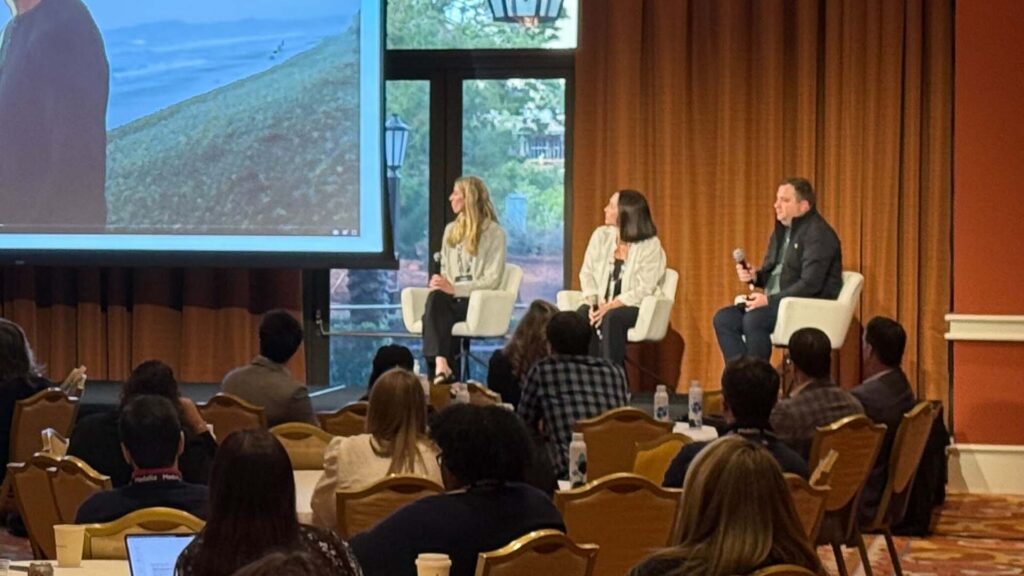
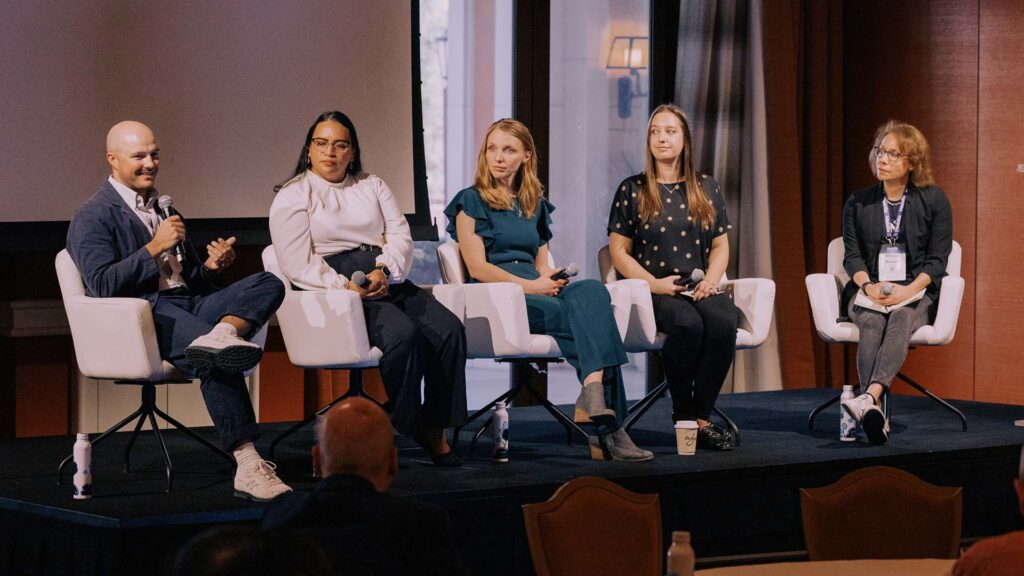
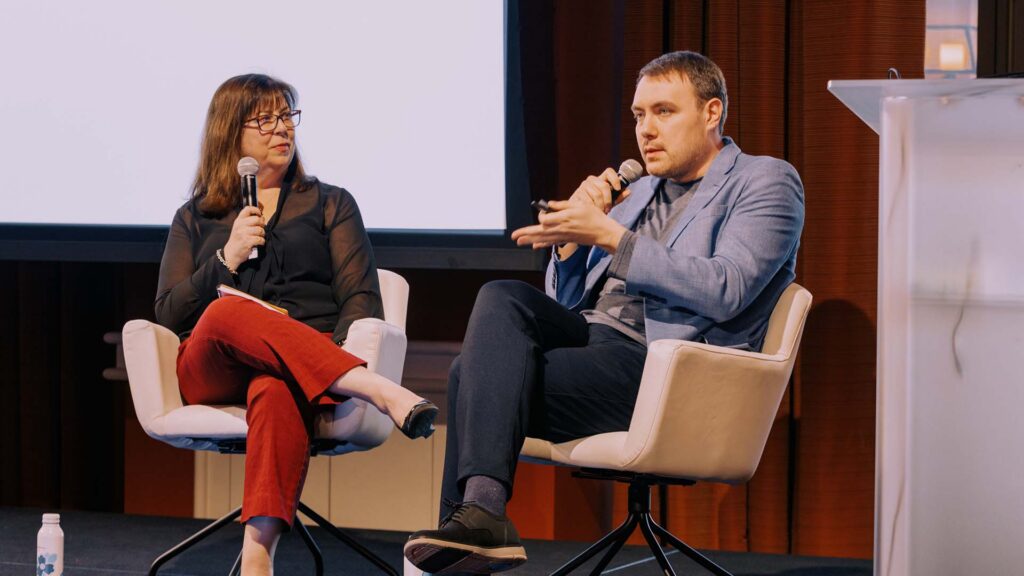
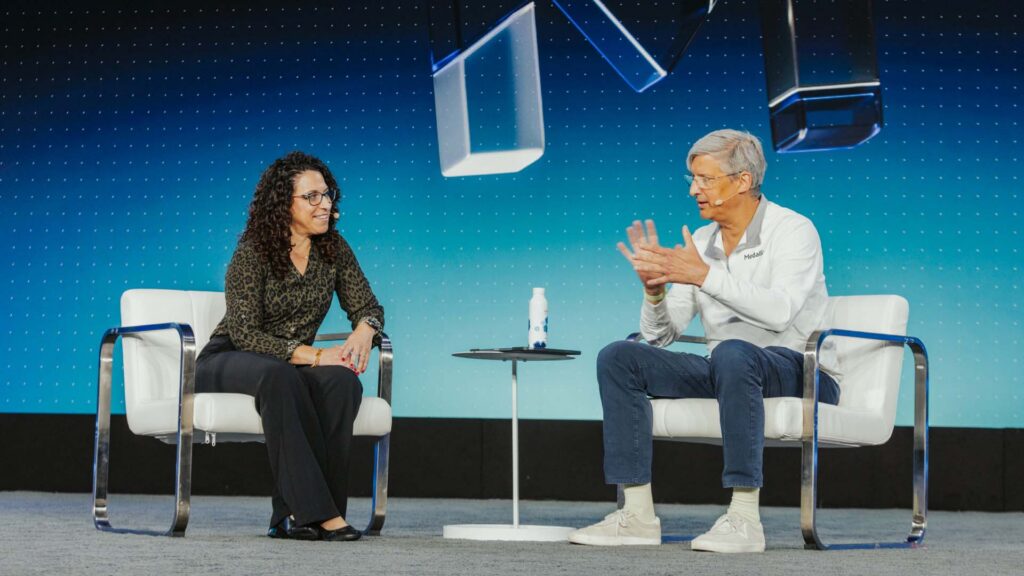
Melissa Arronte: [00:00:00] Welcome. I’m so excited to see so many EX CX fans here today. I’m Melissa Arronte. I lead the Employee Experience Practice at Medallia, and I’m so excited to share this great panel with you and one of our Expy winners too. Anyone who saw the Expy Awards, I hope you heard how many times they mentioned employee I, and most of them are working on CX is, as we know, EX is the last white space in CX, and the combination of the two is really how we connect employee experience to business outcomes.
What you’ll hear from this panel is so much more than the old cliche of happy employees, equal happy customers. We all know that’s not actually true. It’s so much deeper and that’s what you’re gonna hear from this panel today. So I’m gonna start with Natalie, and I’d love each of you to just share your name and your role and how you got to be working on EXCX.
Natalie Whise: Hi everybody, I’m Natalie Whise. I work at Verizon Business with Samantha Scott, who you heard from a few minutes ago. Verizon Business manages our customer experiences for public sector, our enterprise [00:01:00] customers, small business and mid markets. Our challenges identifying what are the opportunities, what are the insights across those different unique segments and their journeys and, on the employee experience side, you know it’s been fun tying back our operational processes, systems, and identifying some of the root causes of our customer feedback.
Samantha Scott: Hi everyone. My name is Samantha Scott and I work at Verizon Business. I lead the experience team for the organization. I came to work on this because I actually started at Verizon 15 years ago answering phone calls, so I was the customer service rep on the other end when you would call in and have a problem and have a billing issue or need to order a phone, that’s what my day-to-day job was.
And I’ve moved up through the organization, but always wanted to stay very close to the customer and make sure that I had that connection on the other end. And so as I’ve moved up through the organization. Finding my way over to CX and ex just felt very natural. So that’s where I’ve been for the last three and a half years.
Zuky Robles: [00:02:00] Good morning everyone. My name is Zuki Robles and I am with Hyatt hotels and I lead the ex programs at Hyatt. I actually started on a very different track. I started very academic oriented during research in the ex space. Along the way I started. Somehow ended up doing consulting. And what I really found is that I liked seeing and applying those research practices in translating them into real life.
And as a result, I pivoted to practitioner work where a lot of my work today is focused on evidence-based practices in the ex space and applying those in a way that’s scalable and practical at organizations and. Lucky enough to end up at Hyatt, which is an industry that I’m truly passionate about in the hospitality space.
So yeah that’s my story.
Cole Halligan: Hi everyone. I’m Cole Halligan. I’m senior Manager of Global Guest Experience at Hyatt. Been with Hyatt for just over five years now. Before I was in consulting doing a number of customer and brand [00:03:00] experience related projects, but the common thread between my background is really in customer experience strategy.
Insights and operations. I’ve been grateful, like Zuki, to find my passion for my work, align with a passion for travel, and then really resonating with the company culture at Hyatt, which is we care for people so they can be their best. You’re gonna hear Zuki and I talk a lot about care through the rest of this panel.
But yeah, really grateful to be here and grateful for the opportunity.
Melissa Arronte: Great. Now the first question I wanna ask you all I think is something everyone is thinking about is how do you bring EX and CX together in your organization? So maybe Sam and Natalie, if you start first.
Samantha Scott: So we have been working, or I’ve been leading what was originally the CX organization since the end of 2022, and we were getting a lot of really great rich insight from our customer.
But there was that missing component of making sure that we were layering in some additional insights and bringing everything into our internal language. So in [00:04:00] early 2024. Verizon business was going through a pretty substantial reorganization, and the org that I was in was bringing products and marketing closer together and realigning a lot of the employees and across the business.
So I seized the opportunity because we had an employee experience team that we called Your Voice Matters that existed in a different work group that was not realizing its full potential. They had a really amazing process and a way of gathering insights, but. I felt that bringing them closer to voice of the customer and the greater CX program would benefit honestly all of us across the board.
So I seized that moment. I reached out and I I asked that during the reorganization process that we bring everyone in together because I do feel very passionately that ex is the smoke to the fire. Cx. So if there’s something going on in front of the customer, if there’s an issue or a broken process, the employee’s gonna be the first one to tell you about it because they’re probably the one [00:05:00] fixing it every single day, and it’s consuming their time, and it’s probably frustrating them as well.
So bringing them in and then connecting everything. It just made so much sense.
Natalie Whise: Yeah, absolutely. And just to add to that a bit, when we’ve been working back with our customer experience feedback, we’ve had very robust inter loop processes in which our employees are already responding back, helping us translate.
What the customer’s actually saying. Tying that back into the changes that we need to make into the business. But a lot of that, again, is just individual coaching or maybe some smaller scale initiatives that don’t drive the business impact that’s necessary for us to reach our goals. And so as the employee Insights team has come into our space, it’s been really helpful to identify how can we be proactive with stakeholders as they’re launching.
New highly complex initiatives, get some feedback on existing systems or processes that might not be working as efficiently today, and how do we actually build that into the [00:06:00] design of their experience going forward?
Melissa Arronte: That’s excellent. I just wanna point out that the Verizon team, they’re in the same organization now.
What we’re gonna hear from Hyatt is two people in different organizations bringing EX and CX together.
Cole Halligan: So we are a bit different. Ex and CX at Hyatt do roll into different functions of the organization. So you could say we’re in a quote unquote silo, but I think there’s two things that have really helped break down that silo.
And one is a shared clamoring and need for data. I need ex data. Zuki needs CX data in order for us to deliver the insights that Hyatt is expecting of our teams. And number two is just our shared. Commitment to our purpose of care, which we believe extends first and foremost to our guests, but equally as importantly to our employees.
So Zuki, do you wanna talk a little bit more about that shared purpose?
Zuky Robles: Yeah. To further emphasize what Cole just said, ex and CX really do work at Hyatt despite being. Completely different functions because it does come from the same place. And [00:07:00] that’s our purpose of care. And so that has allowed us to have the mindset that we view these two things as deeply interconnected experiences.
So it really shifts the mindset when you lead with care to. Questions like, who owns this metric versus that metric? Or who’s accountable for this or that, to really asking different questions like what experience we’re trying to create as a whole and for whom. And we find that mindset has really allowed us to break down those silos so that we can work together towards a common goal.
So breaking down silos, whether that is across HR operations or the many different brands within our organization.
Melissa Arronte: I love this shared purpose, right? If we think about the role of HR in an organization, we have the same job as every other business in the organization, and that’s to deliver for our customers.
And then I love what you said, Sam, about Smoke to the fire. I’m using that from now on. Alright. Let’s talk about the greatest obstacles that you all have [00:08:00] faced and how you’ve overcome them. And maybe we start with Zuki and Cole first.
Zuky Robles: Over the years at Hyatt, we’ve had many different obstacles and challenges, and I think there’s been a couple that have persisted over the years, especially as Hyatt continues to grow and expand.
And those are centered around technology and data, and I’m sure many other organizations can relate to this. Over the years, we’ve inherited tools that weren’t designed to talk to one another, and as a result, we have data that is. Connected in different areas of the organization. And then speaking about data therein presents another challenge.
We have data that is either lacking, so despite it being. Decentralized, it’s lacking or it’s just quite messy. And so we find the challenge in that it really makes it difficult to connect data in a timely manner so that we’re able to action much faster. And it also takes a lot of time and energy for us to clean the data and make sure that we’re confident about [00:09:00] what we’re leveraging to.
Yield those insights. And one way that we have been really able to overcome this it is through breaking down those silos and partnering with teams across the organization, whether that’s our HR IT team, our HR business partners or teams across the operations functions who have been really key and instrumental in ensuring that we’re connecting all the scattered.
Puzzle pieces together, but also in ensuring that our data is valid and ensuring that validity. And I think that’s a really great example of how leading with care for us really shows up and how we work together. Because we’re all really just trying to get to the same goal and where it could be very easy for some teams to say, that’s not my priority.
Why do I have to spend time helping you validate data? No, it’s because, right? We’re all working towards the same. Towards the same goal.
Cole Halligan: Yeah. One add to that is, I think another obstacle that we face is the, it comes down to influence. So for background, Hyatt has been going through a multi-year transformation journey to be in a more asset light [00:10:00] company, which means more and more of our hotels are being owned and operated by third parties, essentially a franchise model.
So what that means is we have more of our hotels delivering the Hyatt experience with staff that aren’t our employees. So that creates a unique challenge. Anyone in a franchise model in the room here can relate to that. That’s just the challenge of making sure that we’re deploying unique tactics to ensure that our operators have the tools and the technology and the insights that we know can deliver a better experience.
And also make sure that our operators feel connected to our purpose of care and feel connected to what it means to deliver a Hyatt experience across our various brands and brand portfolios. Those tactics are a bit different with those operators than how we might deploy them for our managed hotels or our direct employees.
Samantha Scott: I have to say, when Zuki mentioned inheriting systems that don’t necessarily talk to each other, like I felt that, I hope, I feel like everyone in this room probably felt that too, because that was a major obstacle for us as well. Having CX and ex in different worlds meant. [00:11:00] It was in different tools and the data was not brought in together and nothing really felt like it talked to each other, which meant it was not as useful.
So it was a big obstacle for us bringing everything together, and that was number one priority when we brought the teams together, making sure that the voice of the employee insights were moved into Medallia so that we could start to tie the, tie everything together and make sure that the data worked cohesively.
Natalie Whise: Absolutely. And another thing that we’ve been really working toward to remove obstacles is leveraging what’s worked well across our employee insights program and what’s worked well in our customer insights program. Our employee insights program, as Sam mentioned, is changing a bit, but some of the tactics that we’re maintaining are their agility.
A lot of cases, because we’re not running an HR type program, we’re asking, again, the employees about their operations, their systems, and their policies. This enables us to ask basically one time or ad hoc [00:12:00] questions, and then the next time that we’re following up with those employees, we need to ask them different questions.
What do you think about the systems now? How is this now impacting your ability to support your customers? Or is this driving friction within your teams? I think one of the things that we do very strongly on the customer experience side. We have very specific brand drivers, journey drivers. We actually have journey frameworks that we’re mapping these insights back to.
We don’t really have that yet on the employee experience side. So that’s currently an obstacle that we’re overcoming so that we can, again, trend on these insights and tie them back to our customer experience. So just a quick example is in one of our most recent employee experience programs, we’re asking those employees again, to what extent does this policy.
Impact your ability to do your own job, your ability to support your customer or create friction with you and somebody else in the organization. We’re tying that back to the brand drivers of our customers that are telling us, you know what? It’s not all that easy to engage with you. [00:13:00] And we’re responding to that customer feedback by listening to our employees, identifying where effort is also an issue for them as well.
Melissa Arronte: So many excellent insights, right? In how to bring ex and CX together. I just wanna add on what Natalie said, right? She really expanded the definition of what ex is beyond what we typically measure in hr, right? It’s beyond engagement and onboarding and a great place to work, what we’re doing day to day and what gets in the way of us doing our best work, and then connecting that to cx.
Its most powerful and efficient way. To connect EX and cx. The other theme I’m hearing and I hear with any customer that I talk to is the issue of data, right? And we’re trying so hard to get the right data and the data connected to be able to do something. Another way to get started quick, and one of the reasons why I’ve engaged a new partner called uba, and if David and Kevin can raise their hands briefly and you can meet them later, they bring external employee comments.
Connect it with JD Power scores or other CX outcomes. So when we have this data issue that’s preventing us from getting started, we can use that to get some [00:14:00] great insights and help people understand it’s so much more than happy employees, equal happy customers. So I’d love to hear what you all are thinking about your vision for the next 12 months.
And I think we’re starting with Zuki again, please.
Zuky Robles: Yeah. At Hyatt there are a couple of things that are on our roadmap over the next 12 months that I am actually really excited about from an HR and ex perspective. And the first is, we’re. Migrating into a new HRM system. And so this is really going to allow us to solve for those challenges I mentioned earlier, which is technology and data.
We’re beginning the process to be able to centralize that data so that we don’t have to then, jump through hoops to connect all these data sources together. And as parallel work to that, we’re also going through a whole data revamped process, as I mentioned a lot of the data is messy or lacking.
And so this. Parallel work will enable us to have a unified data language so that all the data is meeting the same data governance standards and data parameters that, the organization wants to put in place. And so that’s gonna [00:15:00] be really helpful for us in order to access these data points and be able to have more timely insights that we can act on.
The second piece that I’m really excited about is our migration to the Medallia Experience Cloud. We’re shifting to this new platform that’s really going to allow us to link our ex and CX data more seamlessly than we do today. And so as part of that, leaders will have access to this new tool where they’ll be able to have insights on all of our ex programs and CX programs to be able to synthesize those insights in a much faster space.
And then last but not least, another thing that’s a focus for us over the next 12 months is really focusing on those ex drivers of the guest experience. Over the years, we’ve done a lot of work to really hone in on what about the colleague experience drives or matters the most to the guest experience, and we’ve been able to pinpoint what those factors are.
So over this next year, what we’re really focusing on is embedding those into our existing talent [00:16:00] processes such as performance management. Or development programs. And the idea behind that is to really create an environment where colleagues feel supported and enabled to deliver a differentiated guest experience.
Across all of our hotels, and I know Cole, you’re doing some work in the CX space that helps fuel this action chain.
Cole Halligan: When we’ve met to talk about our 2026 priorities, we listed them all out and all of them rolled up to two areas really. One is more signals and two is less time to insight. More signals, meaning where can we leverage more structured and unstructured data that allows us to understand where there are pain points in the guest experience before we hear it reactively on a, on traditional experience survey that we have.
So last year we spent a lot of time in the contact center space getting signals closer to the interaction. This year we’re working on bringing call transcript data, chat transcript data into the medal experience cloud and bringing more metadata about the interaction. So we’re really excited for that [00:17:00] progress.
There’s a lot we can apply to our other programs with that too. And then less time to insight. I always have to ground myself that our frontline colleagues are extremely busy. They’re wearing many hats. They’re oftentimes running around the hotel. So it shouldn’t be a science project for them to understand what are the biggest challenges I’m facing?
Where are we delighting our guests, and what’s the next best action I need to take today? From an analytics perspective, we’re really focused on. Being more pro proactive and predictive about the experience, and more importantly, more prescriptive on how we can act to drive action. So we can reduce that decision fatigue that our colleagues are going through in the frontline and make sure they feel empowered that the decisions they are making are data driven.
Samantha Scott: I would say over the next 12 months, and honestly, it. Pardon my corporate speak for just a moment, but what I would say is we’re gonna be putting on a display of bold orchestration. So Natalie touched a little bit on the policy transformation survey that we [00:18:00] launched, but I wanna really make sure that you understand like the work that is being done there because.
We are actively using our employee base to source how we can fix things for our customers that have been broken consistently for years and years, and things that we feel like we’re never able to get past the hump and truly solve. So we’ve proactively reached out to our employee base and said, tell us what’s broken, what policy, what process, what system is getting in your way of doing your job effectively and making sure that you can serve your customer appropriately.
And this, the survey has been fielding for about two weeks. It closes tomorrow, and we’ve been reading through the responses. We’ve had 2000 partial to complete responses so far, and still more coming in over the next 24 hours. And when you read through the feedback. It’s not, I don’t wanna go into the office or I don’t like whatever process or something like that, but it’s so thoughtful and you can tell that these [00:19:00] employees have given it some thought.
They’ve probably been thinking about it for a while, and we can really use this employee feedback to try something new and try something completely out of the box because our employees are helping to feed us the right information. They’re in it, like they’re in it every single day talking to your customers, using all of these systems that get launched and they are the best ones to tell us how to do it differently, how to think about it differently and how to get it fixed the first time.
That’s what we are doing. We’re really leaning into it.
Natalie Whise: I think one aspect that we continuously talk about in these sessions and also on the keynote stage. Is the importance also of just the culture and we have this ability, I think, to take these actions, to solicit this feedback and know that we can actually put some force behind it to correct these issues.
At this point, because our CEO is talking about it, our business group, CEO is talking about it. And we just had that level of support. So I know Zuki mentioned, mutual [00:20:00] intent and everyone is busy. Everyone is running, a thousand miles a minute. At the same time, we know that these are the right things to focus on.
And by driving this back into our leadership’s core objectives, I think is both empowering us to ask for this feedback and then also to action on it. I think, to my point earlier, we’ll also be focusing in on the insights ecosystem and that framework. It does include surveys, but there’s so much more to that.
We have so much operational insights from, again, our customers that we’re already tracking and using on scorecards, but also a lot of other opportunities to look at operational metrics with the employee insights and how they’re actually engaging with our systems or how they’re supporting our customers in new ways.
Melissa Arronte: So many great points on how to bring EX and CX together. I just wanna highlight something that Sam said about. Those problems that we’ve been facing in CX for years and years that people have just decided this is the way it is. This is the last white [00:21:00] space in cx. It’s the last place we haven’t gone to really understand why do we have these ongoing problems.
Often the employees know that they’ve no way to tell us. This is so critical in bringing the two together and one of the places that once you break one of those that people thought could never be fixed and you break that open, that’s when people really stand up and notice. So now let’s talk about how you leverage technology and bringing the two together.
And maybe Natalie, you can take the lead.
Natalie Whise: Yeah, absolutely. So I’m very excited about technology and data and sometimes I think I, I talked to Sam a little bit, maybe too much about this, but I would say, just for simplicity. I think the most important aspects of bringing customer and employee experience together is again, ensuring that we’re asking the right questions from a customer experience perspective.
We ensure that what we’re asking the customer is something that they know how to respond to, and I think that’s where a lot of us are starting to have, new conversations about what the NPS score means, and how it ties back to our business KPIs. So capturing the right insights and the right moments is [00:22:00] still something that we’re prioritizing.
Again, we’re leveraging Medallia to help capture those insights. We use Medallia Experience Cloud, especially on our customer experience side. A lot of those cases are ongoing. We always wanna understand our transactional insights with our sales, or we have a lot of digital engagement as well. And then we have relationship surveys on the employee experience side, like I mentioned, very agile, so we’re using the Medallia Agile space to do that.
Then it’s aggregating those insights together along with other metrics that you’re seeing on the scorecards. First contact resolution, successful login rates, user adoption to certain to certain products, and then also analyzing that and then acting on it. So the way that technology is doing this, we have our insights framework, but we also have a robust technology ecosystem that’s fueling this.
We have a lot of insights that are coming back in-house and we can, again, enable scorecards or we can create proactive recommendations for our reps. And I think that is really what’s helping us bring ourselves to the next [00:23:00] level of supporting both our customers and then also empowering our employees.
Samantha Scott: And I would say from the technology standpoint, clearly Natalie’s the expert there. But my job is just to make sure that her team has all the right tools, that I can clear the runway so that they can do and be most effective at their job, but really taking that to the next level too. So they launch these great programs, they stand up, these insight ecosystems.
They do all of this great work, but if the other organizations aren’t aware of it or not using it effectively, then. It does no good. So a lot of my role is making sure that we’re driving awareness and education about everything happening within the insight management team under Natalie. Making sure that there’s an education component and honestly following up with other leaders that maybe need to be leaning in a little bit more with their organizations, understanding what their customers are saying and really how, like what that actually means to them and how it can benefit them long term.
Zuky Robles: We faced a lot of [00:24:00] technology challenges at our organization, but despite some of those challenges, the way we still see data, we still see technology as a huge connector and a huge benefit to the organization. And so one way that we’ve been able to really work around a lot of the technology challenges through integrations for us.
And so what do I mean by that? We leverage Medallia. And so a lot of what we’ve been able to do is. Start feeding in and connecting some of our data sources and our technology pieces into Medallia, whether that’s other colleague data that’s external to Medallia and feeding it into their platform. An easy example of that could be as simple as your turnover data so that you’re able to really see, or leaders are able to see the impact of turnover across their hotels or across the regions, and then vice versa.
Being able to translate Medallia colleague data or survey data in general into our internal tools at Hyatt. So we’ve been able to leverage things like Tableau to create dashboards for leaders so that they can have insights all in [00:25:00] one centralized space, and they’re able to see the impact of talent strategies across numerous areas of the organization, including things like the guest experience financial impacts of some of these talent strategies.
And last but not least, obviously, like many organizations, AI is a huge factor for us at Hyatt, and I know Cole has been working a lot in that space. So maybe you can talk a little bit more about that.
Cole Halligan: Raise your hand if AI is on your company’s roadmap for technology. Okay we have a lot of ways to go with ai of course.
But we have been looking at what are some low hanging fruit and also some big bets. So one example recently we’ve lever been able to leverage AI to pick up recognition in instances where our co in feedback where people are being recognized by name or by department in a positive way and really scaling that at an enterprise level.
And we’ve done some really creative and interesting initiatives on rewarding and recognizing colleagues that are going above and beyond. That’s powered through the technology and AI space. [00:26:00] Another way that I think AI is such a sweet spot, especially in guest experience, is there’s so many touch points in the guest journey where we’re relying on our frontline colleagues to have to make really important decisions.
Really quickly under a lot of pressure and without a lot of data and context to help them. So this goes back to what I was saying earlier about being more predictive and prescriptive. I think AI can help us predict the experience better. So an example, Zuki checking in today. We know through loyalty and stay behavior data that she’s a very high value member, but we also know through that data and maybe voice of customer as well, that she’s likely to churn.
So we already know that. We predict that as Zuki enters check-in the prescriptive side is, can we enable some action or recommendations for our frontline colleagues to say Zuki iss the high value member, but she’s at risk right now. Maybe she, we recommend Zuki gets a sweet upgrade or her favorite wine bottle delivered to her room.
I think the combination of prediction and prescription is really where, what I’m [00:27:00] excited about with ai, and you could take that use case across. Pretty much the entire guest journey. Just alleviating that decision fatigue. And again, making sure our front lines feel empowered when they make a decision.
It’s data driven.
Melissa Arronte: Again, so many great insights. I just wanna highlight something that Zuki said that I think is so significant, yet so simple. At the same time, you already have data flowing into Medallia about who’s using it, right? Employee data that’s coming in, and that data can be used to show who’s terminated and who’s still here.
Just bringing in that simple signal. So insightful. ’cause we all know employee turnover impacts our customers and you already have that signal coming into Medallia. I’d like to ask now about an example of a valuable EX X insight and if I can ask Cole to start first.
Cole Halligan: Okay. I have an obvious one, but I think it’s a good data point that shows the connection between EX and cx.
So last year we did a lot of work on looking at turnover at the property level. And really we were able to find at what point or at what level of [00:28:00] turnover at a property do we start to see a tipping point into the guest experience. So step back, obviously we all know turnover has a negative impact to guest experience, but being able to know that exact tipping point.
Has allowed us to know exactly when a hotel might need some dedicated intervention and support to get ahead of issues before it starts impacting the guests. And it’s also helped validate a lot of the investment that Hyatt has put into. Our onboarding and training programs. For example, we know GMs that go through our full general manager university program have seen lower turnover than those that don’t.
So this data point a again, just helps us be really intentional in our attention of where we need to spend more focus with hotels and just keeps validating that investment that we’re putting into onboarding. Zuki. I think you have another example of a CX EX insight as well.
Zuky Robles: Yeah. Cool has been talking a lot about being prescriptive and I think a huge shift for us has been being able to quantify [00:29:00] relationships.
And so what I mean by that is moving from being able to say things like these two things are related to being able to confidently say, if I move the needle on this specific ex. Factor, I can expect to see a measurable point increase in the CX driver. And so that level of prescription has been able to allow us to get our leaders to focus on things that matter the most.
And that is particularly important for a fast-paced organization like Hyatt, where as we mentioned, leaders and colleagues are running around doing a hundred different things. It is very helpful for them to. Know what they need to focus on or what is the one thing that’s going to matter the most?
And so we found that has really resonated with leaders across the organization because instead of telling them, oh, you need to make all things better, no, we can confidently say, I. Just improve this part of the colleague experience, and you can expect to see an impact on this [00:30:00] part of the guest experience.
Natalie Whise: Yeah, I think, again, when we look at our strategic surveys with the relationship focus, we can get a lot of. More holistic insights than we get when we were just looking at a transaction. So one of the pieces that we noticed wave over wave is that ease of doing business was popping up in our customer feedback.
We were hearing that issue. Resolution was a really big thing. Customers were having to call us multiple times. They were trying to engage with us in multiple channels and they just couldn’t get through the red tape. When they were reviewing us in that transactional insight, we were getting very positive feedback.
They like working with our people, but something in the process is broken. So last year we ran in a sales and support basically post-survey, I will say, to ask what’s actually breaking down when we have these two different teams working together, trying to support their customers? How can we improve this?
We’ve been able to take some great action. Reducing friction between those two [00:31:00] groups. Sales and support are absolutely critical. They’re very important functions within our business. They’re the front lines, they’re the ones that are supporting our customers. And so by reducing that friction between those groups, they’re working more effectively together.
There’s less friction, and then our customers are being supported more holistically.
Samantha Scott: Yeah, we actually even doubled down on that effort. When our customers are telling us that they’re calling in multiple times and their issues are not resolved. We take that very seriously. We did dig a little bit deeper and we identified what we are calling chronic callers.
So we’ve tagged them as customers that call in three or more times within 30 days. And we’ve established a whole program around it, making sure that we are taking a proactive approach and actually reaching out to our customers and saying, I’m so sorry. I can see that you’ve called in multiple times. I first wanna make sure that your issue’s taken care of.
If not, please let me help you right now. And we have an entire intervention model around it. But what we’ve uncovered. Is that there, there is a [00:32:00] true gap that we can serve on the other end, and it’s the employee experience component. So making sure that if, there’s a high driver of billing issues that we’re understanding, is it a training thing?
Do we need to make sure that there’s additional training on how our bill look, looks and feels, and how to explain it to a customer. Or is there maybe something that’s actually broken that we need to address and make sure that there’s a billing error that’s rectified? So it’s been a huge learning moment, but it all stemmed from what Natalie’s talking about our Voice of the Customer program, and then doubling down with our employees.
Melissa Arronte: Oh, excellent example. Thank you. So in a minute I’m gonna give you all a chance to ask a question or two. So you work on getting those ready while they answer the last question for me. So if you can share with me a story and its impact in this area, and maybe starting with Sam.
Samantha Scott: So we actually, and I’m gonna talk a little bit more about chronic intervention because I am very proud of this program.
So we stood it up in, late last year, I’d say early Q4. And what [00:33:00] we found is that it actually produced like a really amazing outcome. And so not only did we learn a lot about all the broken things that might be happening on the front end with our employees but we’re really understanding at a deeper level.
Why customers are even having to call us in the first time. Because a true, good experience is that it’s so easy you never have to contact us. So we’ll always continue to have our voice of the customer program where we are actively soliciting feedback at all of our transaction points. But.
Introducing in another touch point where we can mine information from our employees that are doing the proactive outreach and understand exactly what is happening at the forefront of the conversation, helps us to prioritize where the fixes need to be on the other end. ’cause ideally, we get to a state where not only we don’t have chronic callers anymore, but we are having customers that either are transacting digitally or maybe they don’t have to call in at all because they’re not experiencing any issues.
Zuky Robles: At Hyatt, we [00:34:00] have this program called Success Stories, where we really source and highlight stories across the organization where leaders are successfully leveraging EX and CX data to make meaningful impact. And one of my favorite stories is quite simple. It’s a simple one and that is why it’s my favorite.
But we had a hotel who was dwindling in their scores in both guest and colleague. Feedback channels and particularly at their front desk. And so this was really an alert because we were like what’s going on at the front desk and at the hotel that all of a sudden our scores are going down in, in both areas of the colleague and the guest?
And through digging through the data and understanding the feedback from both guests and the colleagues they were able to determine that the issue was quite simple. It was just internet issues. So what was happening was that the wifi at the hotel was not working the way it should be. And so as a result, the front [00:35:00] desk colleague was having a harder time with the technology to be able to check in the guest at a, in a timely manner.
And so this was creating a lot of stress and frustration because colleagues didn’t feel enabled to be able to do their job correctly. And on the other side of the things, the guests were feeling that friction because it was taking them longer to be able to check in. And so this really created a negative experience on both sides and an experience that we wouldn’t have been able to connect had we not been able to look through both the CX and the ex channels to really find the root cause of what was happening.
So once the hotel was able to determine that and fix the issues with the internet, we did see the scores for both EX and CX bounce back up. And so that is just one simple way that really shows that. You don’t have to action on this major thing to make, to move the needle or to make improvements.
Sometimes it’s just something as, as simple as upping your wifi plan.
Cole Halligan: I’ll do a quick note story about [00:36:00] engagement. We know that our hotels that are really engaged in our tools, our technology. Our insights deliver great experiences. So we’ve been creative with gamification in trying to create little challenges throughout the year, especially during D, difficult parts of the seasons, and we found some great, there’s numerous hotel examples specifically, but what I love is that we not only see increased engagement and we see a guest experience improvement in a pretty short timeframe.
What has come out of those challenges is just seeing how much. Of an impact it has on the culture of the hotel. So we get pictures from GMs showing how they’re building action plans. We’re seeing them running a bunch of different experiments in a really agile way to see what’s working and what’s not.
New recognition programs are bubbling up, so a key learning for me is that. The outcome or the outcome is that guest experience improvement. But underlying that is really like a culture change that I hope through these little gamification tactics is a spark that maybe a hotel needed to [00:37:00] create lasting cultural change at the hotel.
Melissa Arronte: Excellent. Now, I’ve only left you all two minutes to ask a question, so gotta be super fast. And we have a mic if anyone wants to ask a question.
Audience Question 1: Hi, my name is Katrina Tan. I’m at a small local bank in Hawaii. And my question is how do you reconcile? It sounds all great to combine CX and ex but politically it can be really difficult to combine those.
And I wanted to also just name Dr. Robles, you are incisive. Been so good, no flu. Such good examples, really precise. So I’m taking a lot back. Please come visit your Hyatt at Waikiki. It’s been really difficult to find a way to reconcile that politically, especially ’cause CX often gets a bigger budget.
So if you could speak on that would be super helpful.
Cole Halligan: I can start with that, but I think the whole, this whole panel has a great perspective on that. I do agree. First of all, I we feel that, I think everyone in the room probably feels that. Tension between ex and cx. Especially in our world, being in different parts of the org makes that more [00:38:00] difficult.
I, I think this might be generic, but I think data can be nonpolitical. I think that has been one of the things that has brought our teams together is that. We need, we both need data from across both teams to make our teams better and more valuable for our company. So I think maybe a starting place to reduce the tension is really just that shared desire for, Hey, we all, we both need the same data to make our jobs better and drive value for the company.
And hopefully that’s a good starting place beyond getting into more like. Org chart hierarchy, investment funding, decisions like that.
Samantha Scott: And I would say for us, ’cause our structure is obviously different, we are one organization at this point, and for sure that was political at the time because living in different organizations means that you were going different directions sometimes too.
But I was able to seize an opportunity when there was a larger restructuring going on. I had buy-in from my executive leadership as well, and you [00:39:00] have to make sure, what Cole was saying, that you’re really grounded in data and the facts. So it cannot be a land grab where you want additional headcount.
It really has to make sense for your organization and for. For Verizon business it did because we had an employee experience team that could be more effective if they were using our systems and tools, if they were plugged into all of the teams that we were plugged in. And so making sure that there was a benefit that all could feel and reap that’s where we were able to make that move.
Melissa Arronte: I see the greatest success among our customers and when they’re starting by solving a business problem. We have a leader who has an issue and coming together with our data is the way we solve for it. When we start just bringing the data together, people are wondering what they might get out of it.
We’re solving business problems and it flows well from there. Sorry we didn’t leave more time. I’m sure the group would be happy to answer questions for you if you wanna come up and see them after, but I want to thank you all. It was so insightful. Really appreciate your times.
Cole Halligan: Thank you.
Melissa Arronte: Thank [00:40:00] you.